

I usually go into these reviews with a rough idea of what score the game will get before writing down my thoughts. It might go up or down depending on what I end up concluding, but I’m pretty sure of my overall take from the start. For Faraway, however, I have no clue where I’m going with it, so now I’m just journaling the process. Which has me dumbfounded: how can a game with such a simple conceit leave me feeling lost in space? I think the main takeaway is that, despite appearing as a straightforward puzzle game, Faraway’s intricacies are unfamiliar territory.
The subheading isn’t just an attempt at pithy wit; it’s a statement of what I think Faraway is evoking – bear with me. Faraway is a modern-day version of Tetris, in that anyone can pick up and play Faraway, but the skill ceiling, from where I’m looking, is unobtainable. I can’t wait for more people to get their hands on this, and I can watch them grasp its gameplay mechanics – and maybe even feel some vindication. Vindication for what? What am I stalling to type out? Faraway has essentially bested me, for now anyway. Faraway is solo-developed by Steph Thirion, who’s made everything from the game’s code to its music. So to say they’ve potentially made the next Tetris is quite the endorsement of its quality.
You play as a shooting star, dreaming bigger before fading away. To do that, you are to make as many elaborate constellations as possible before fading away. From the top-down perspective, you control this shooting star by holding down pretty much any button (this is a one-button game). Staying pressed down on a button magnetises you towards the closest star in the sky, which you then orbit for as long as you hold onto it. Circling around the star, letting go slingshots you in the direction you’re currently facing; then you can hold onto a button again to orbit another star. When you let go determines the speed at which you propel yourself. This is indicated by a ring showcasing your trajectory with a colour gradient from red to blue. Red means fast, blue means slow.
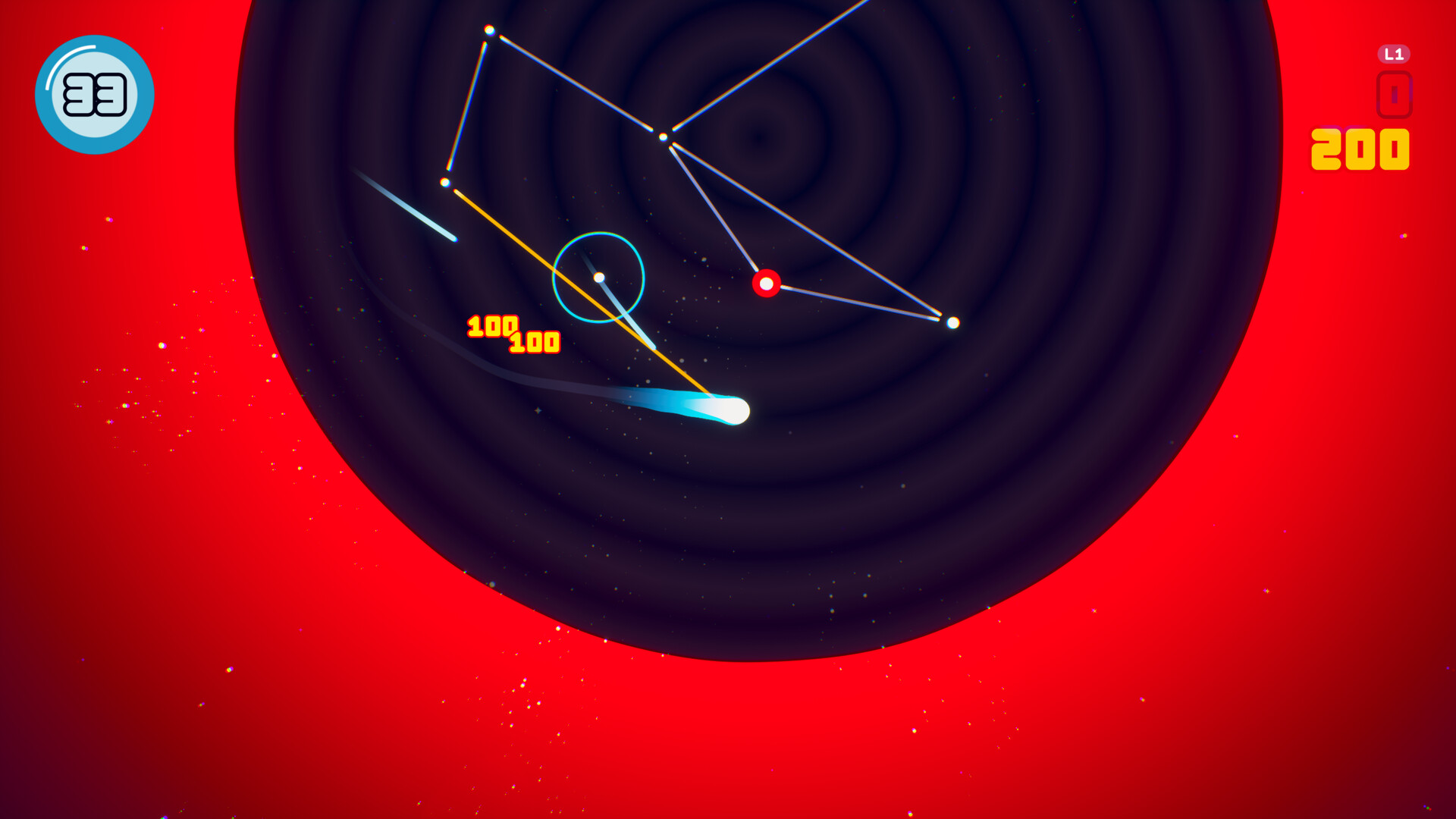
You’re essentially traversing through space by swinging around the stars and propelling yourself in a desired direction. The “game”, however, is learning how to effectively move between stars until you reach constellation zones. These zones are a circle containing a litany of stars, and your goal is to orbit around all of them to form loops and create a constellation. Easier said than done, though, as when you attach yourself to these stars, you’re drawing a literal line which then connects the two stars you’ve orbited.
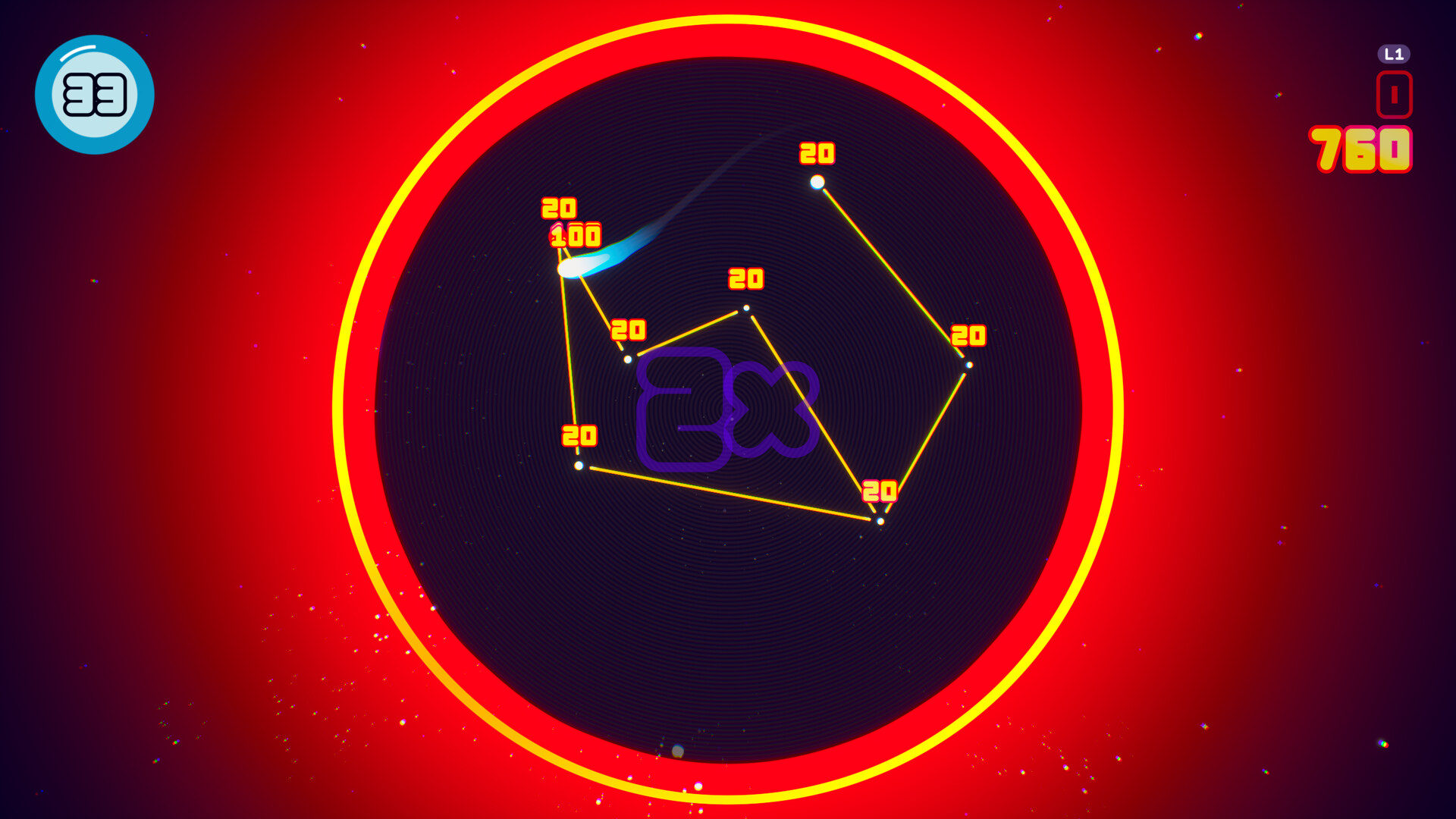
Think of it like a rollercoaster ride of dot-to-dot, but you can’t go through the lines you’ve created between stars. If the star you control or the line you draw interacts with another line, or you go out of the zone, the constellation is considered complete. This then gets you thinking about how to utilise each star in the zone without committing the fail states I just mentioned. Loops are when you connect a cluster of stars into a closed shape, and the more loops you form, the better the multiplier you get. This is in the game’s base mode, titled literally Faraway mode.
Faraway mode is an “endless mode” where you have a timer to go to as many zones and create as many elaborate constellations through its procedurally generated world. As I mentioned, loops give you a multiplier and using every star doubles your points. The points you earn increase your level, which in turn gives you bigger zones and more stars to connect. I have probably spent around 8 hours at the point of this review playing Faraway mode, trying to get the best high score you can get. I definitely feel an improvement from hour one to where I’m at now, but I’m still not good enough to just keep going.
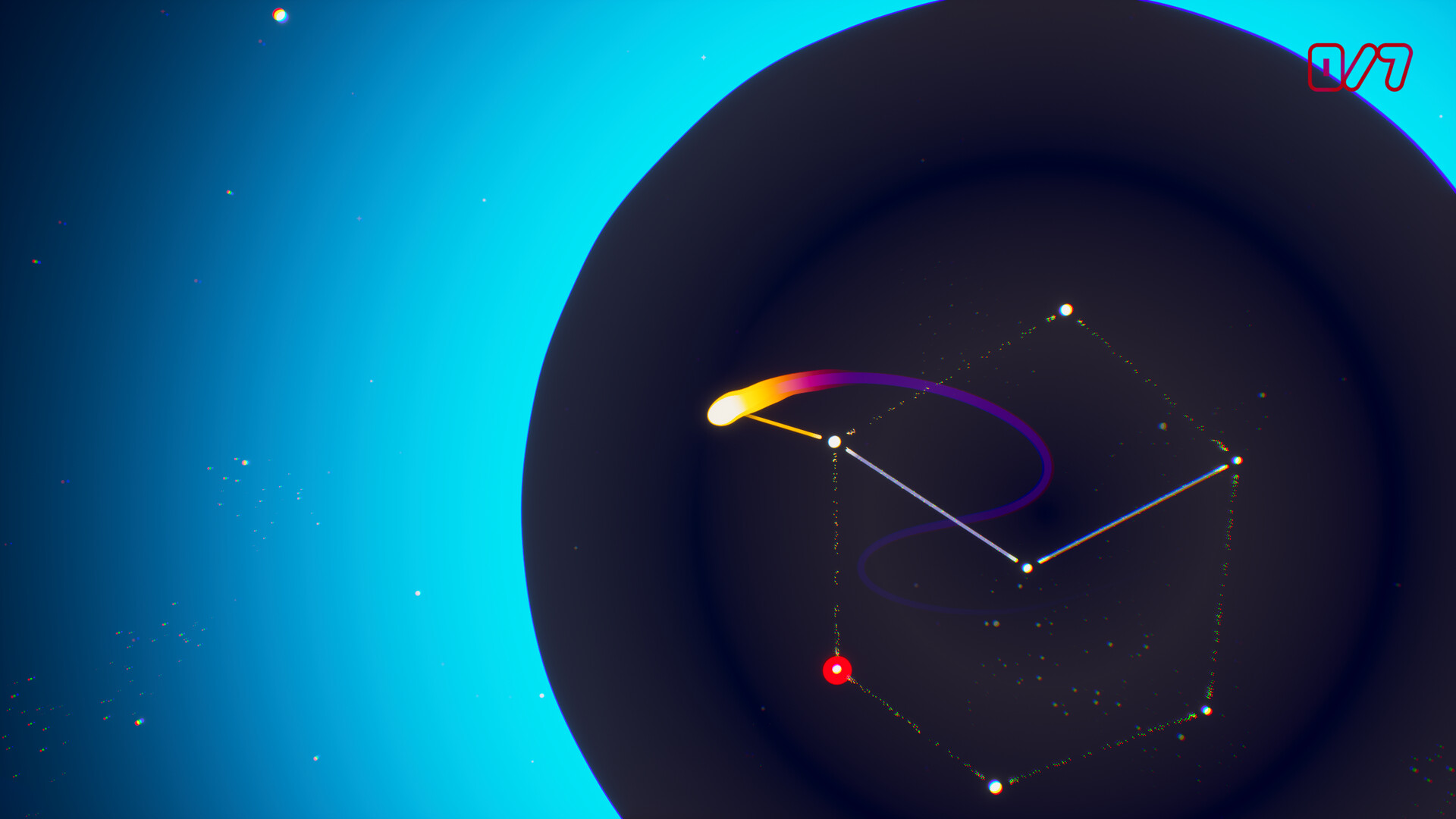
With this feeling being completely familiar territory, and so far being the only one I know playing it, I can’t quite tell if it’s me being bad, or the game just not being as technically flawless as it proposes at the start. Oftentimes I will be going in one direction, thinking the game will magnetise me to a certain star, only for it to be one I didn’t want, making me fail. Or I’m going to a star I want to; I hold down the button to orbit it, or tap to nudge me in the direction, for the game to then go to a completely different one than I intended, to then make me fail again.
At this point, I just didn’t know if I was playing Faraway wrong, or if it’s still in need of some fixes. The Steam page states that it’s designed for “long-term mastery”, so I’ll chalk it up to me being so fresh to the gameplay. Although Faraway could do with some tutorialising, or something to nudge players in the way to play it. This is partially tackled through levels called Echoes and Ascent. Echo levels are pre-determined constellations that highlight the shape it wants you to make. You need to think about the gameplay mechanics and solve the puzzle of creating the image it presents.
Ascent levels give you a set constellation, and you need to visualise and execute the best way to create as many loops with all the stars for the highest score. Both are active ways that improve your skill set, but I’d argue it’s still not quite enough to “learn”; rather, you’re succeeding through failed repetition. It’s this failed repetition that got me seething. Someone else will surely find the process of trial and error part of the fun, and for a while it is. However, I’ve sunk tens of hours into it now with no insight into the matrix of Faraway.
With puzzle games you see patterns, learn the architecture of a mechanic and examine its potential with a critical eye. Me? I was just a shooting star trying to find the spark. Despite my curmudgeonly viewpoint, my stubbornness far exceeds my patience for failure, and I’m still visualising constellations and how to tackle them best in my head.
Some of my visualising is due in part to the game’s bold and simplistic art design. Everything contrasts against the blackened night in a psychedelic manner, whilst the sound design features analogue electronic harmonies and drum lines that tap alongside the freneticism of the gameplay.
And that’s why I claim Faraway to be the next Tetris, Lumines, or Puyo Puyo. These are games that are straightforward and replayable, only to lure you into the cavern of potential once you’re in. I struggled to enjoy this. Even thinking back to it now, I can’t even admit to having fun necessarily, but I was challenged, stimulated and ultimately determined to go as far as the stars would take me, and that speaks to Faraway’s game design brilliance.
Faraway is out 5th November for PlayStation 5 (review platform), Xbox Series X, Nintendo Switch, Nintendo Switch 2, iOS and PC via Steam.
Developers: Steph Thirion
Publisher: Annapurna Interactive
Disclaimer: In order to complete this review, we were provided with a promotional copy of the game. For our full review policy, please go here.
If you enjoyed this article or any more of our content, please consider our Patreon.
Make sure to follow Finger Guns on our social channels. Twitter, Facebook, Twitch, Spotify or Apple Podcasts – to keep up to date on our news, reviews and features.