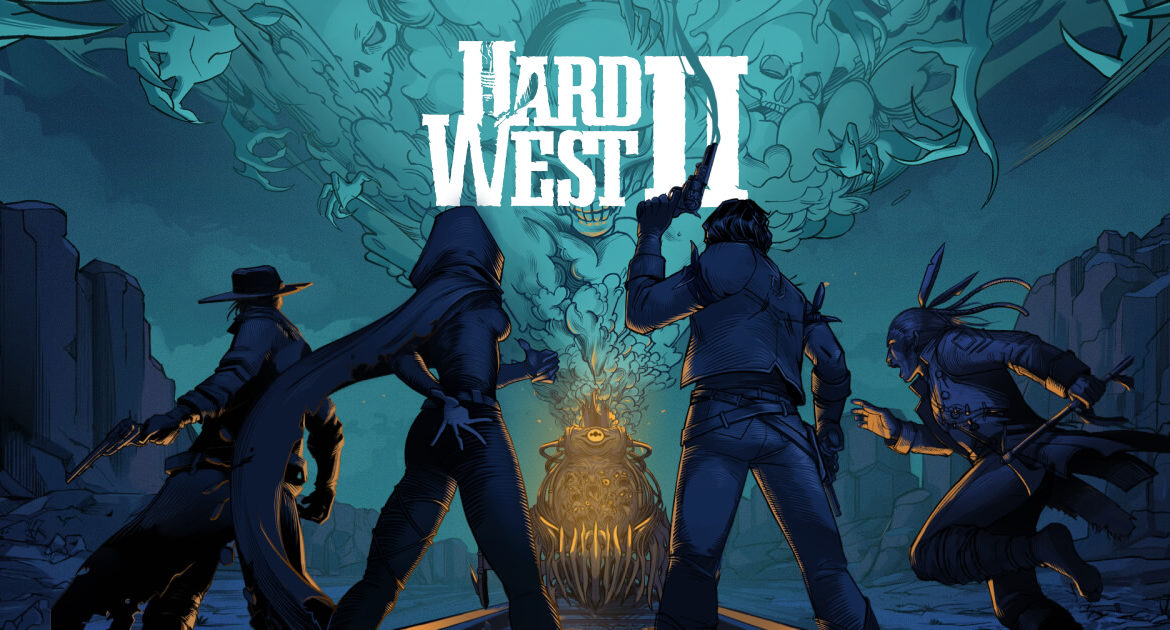
Turn-based tactics with killstreaks, set in a dark supernatural Wild West, Hard West II has made the long trek through the Oregon Trail to its console release this week. With some fairly diverse influences, from Disco Elysium to Midnight Suns, it’s an interesting proposition. I don’t know about you, partner, but imma load my six-shooter, saddle up, and see if we can’t drive some cows through this one. You game?
Streets Of Laredo
In Hard West II, you play as a posse of outlaws led by gunslinger Gin Carter. Gin is joined by various other characters, including native americans shunned by their tribes and willing to help the whites, an undead cowboy, a young witch, a fallen preacher, and others that you pick up over the journey. As a posse, Gin and co start the adventure trying to rob an infamous ghost train (can’t be real though, right?), only to discover it really is a ghost train and only just escaping with their lives. While you reunite with some of the posse over the next mission or so, Gin’s best friend Kestrel Crow doesn’t make it out and gets set up as the villain of the piece alongside the Ghost Train’s owner, a devil man called Mammon.
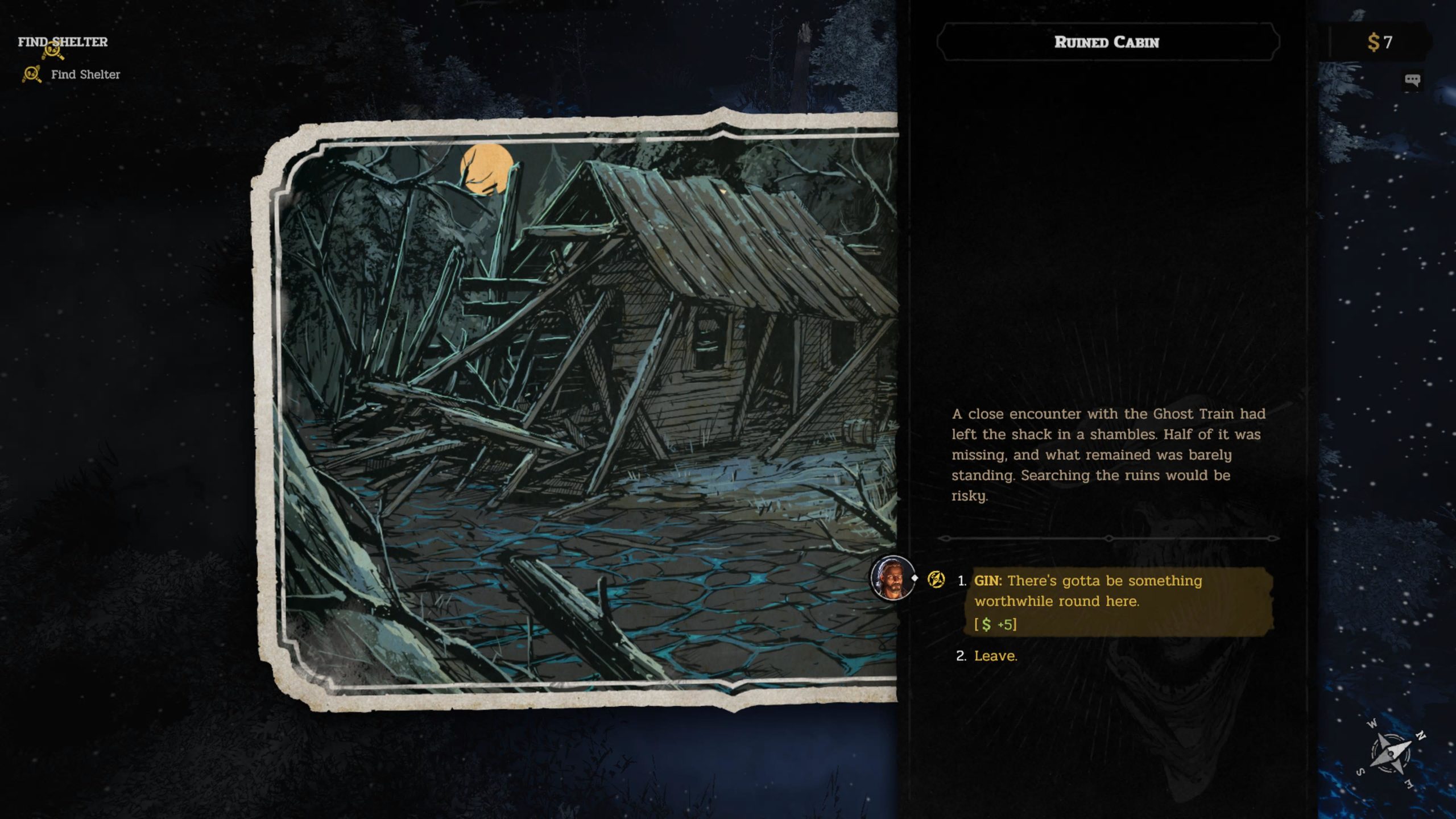
A perpetual winter has fallen over Oregon and Idaho, and Gin and co must strike out across the country looking for Mammon and Kestrel and the ghost train, all the while taking on bounties and helping townsfolk and settlers, villagers and officials along the way. The overall plot may be a simple one of quest and revenge, but the individual areas, towns and NPCs are full of incredibly bleak little vignette stories to tell, all presented in an almost novel-like format. Think Disco Elysium in presentation with the text prose and dialogue on the right of the screen, a lot of which is voiced but not all, and various responses and choices to click along the way.
This makes every encounter an engaging interactive event, but it also forces a fairly high amount of reading, even more so than in some lengthy RPGs, as you are reading the prose as well as the dialogue, the what and where and descriptions, like you would in a novel. By the end of the game, I felt like I had read a full-length novel.
If I was feeling very charitable, there’s some kind of highbrow story in here about the advancements of technology ie the steam train, being the death of the old way of life, but I’m not sure it’s as intentional as all that. This is a supernatural adventure, chasing a ghost train across Oregon, and it rarely pretends to be anything but that. Westerns have a lot of cliches and stereotypes, and they’re all here, but it’s all written well enough that it doesn’t matter much. The narrative’s bleakness was the real bullet through my enthusiasm.
True Grit
Just covering out-of-combat gameplay first, Hard West II features top-down small levels of open country covered in snow for the most part, which you drive your posse over and investigate dwellings, towns, abandoned hovels, and tribal camps. Each one could offer up an NPC, a bite of story, or some loot. Bigger ones will be full-on tactical levels to battle through.
I appreciated this attempt at making the world of Hard West II a little more visual and interactive. The very static dialogue and story sections, and sitting on a grid during combat, could have easily been matched with place card interludes, and have been in other similar titles. Here, the exploration sections add to the overbearing winter atmosphere and brought home the world of Hard West II probably better than the combat or story even does. However, what it reinforces is the utter bleakness of the situation.
Dead Man’s Walk
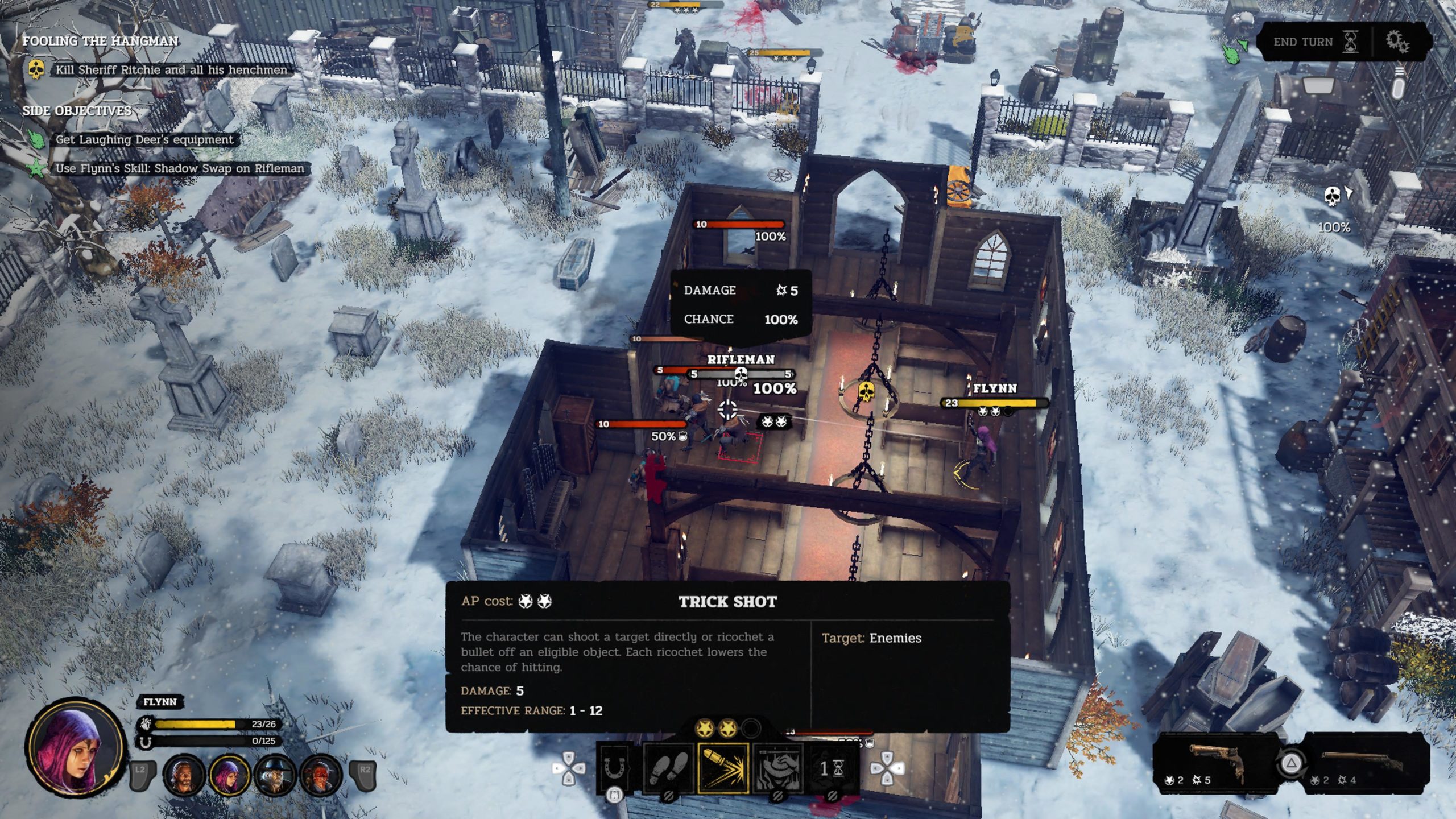
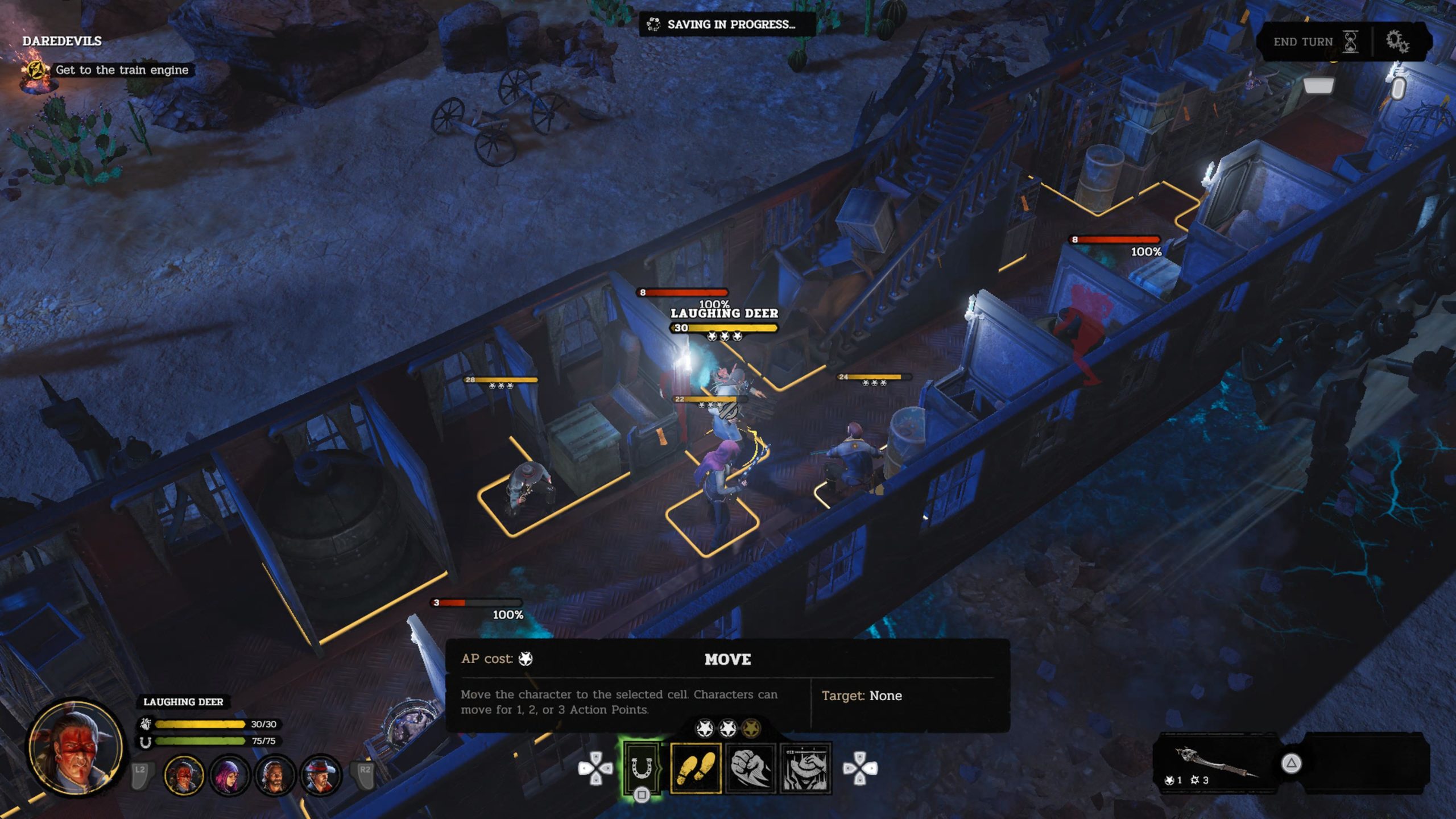
It’s a turn-based, grid-based tactics title, so large swathes of your time in Hard West II are going to be spent on the grid battlefield in some frontier town, station, or out in the wilds. You know what the format here would be from other games, but essentially you have three AP or ability points per turn for each character, and the combination of movement, action, or a special move will use up said AP, ending your turn. Hard West II changes up that formula in a few distinct ways, and the main one is in the Bravado, or ‘kill streak’ system.
Use your AP to deliver the killing shot to some outlaw or undead, and you get Bravado; this recovers all three AP, which allows you to move and shoot again. Kill another villain and the cycle continues. With good placement and luck on your side for damage, you can strut one of your characters right around the map as a one-man army taking scalps left and right. Alternatively, you can use weaker characters to whittle down enemy health and then use characters who you want to have a second shot to deliver the killing blows. It works until it doesn’t, as enemies become too hard to kill in a small number of shots.
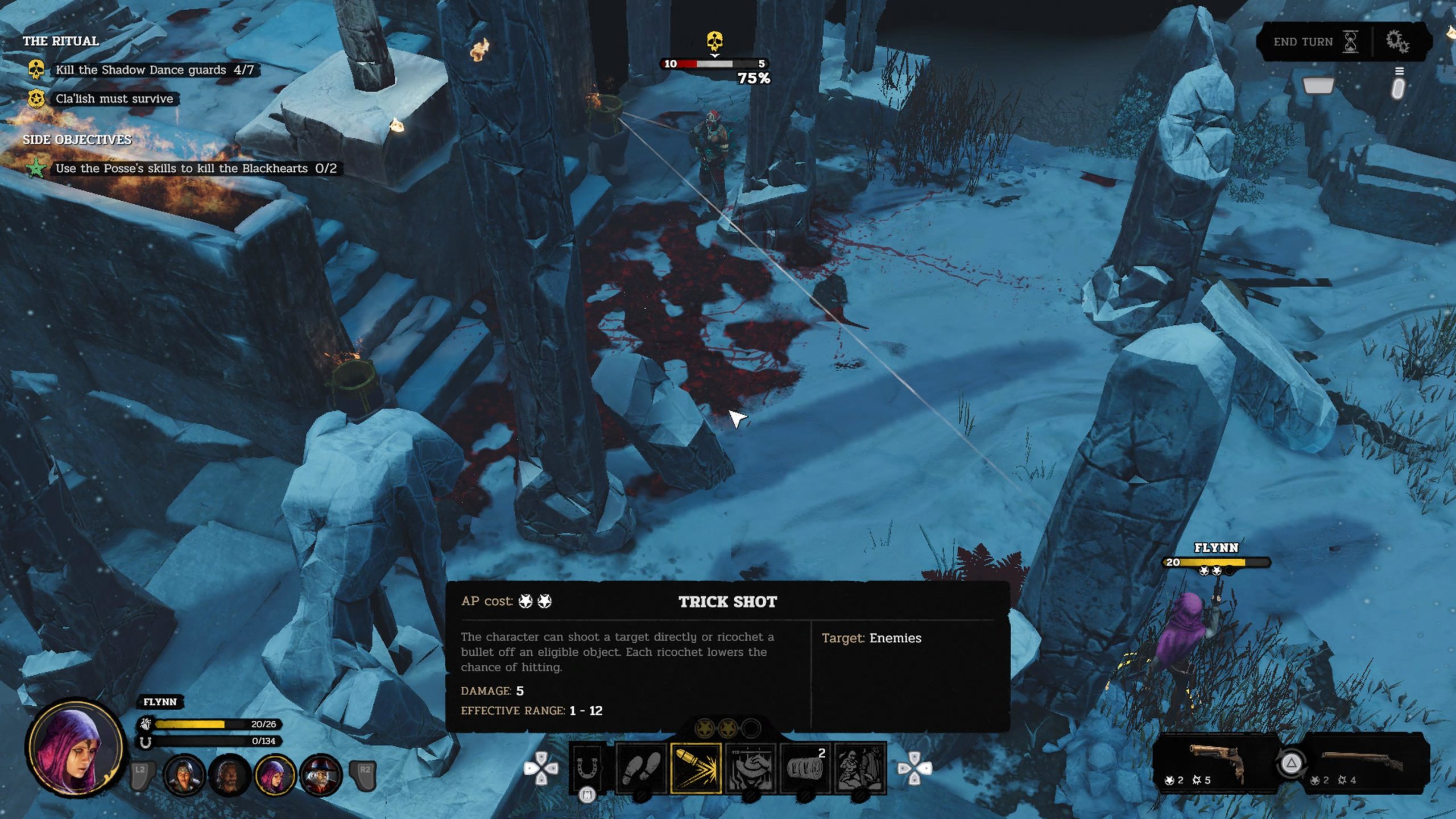
The second mechanic worth mentioning is ricochets. Virtually all the pistols I picked up had the ability to do a Trick Shot. Scattered about the combat maps are various metal items – barrels, chandeliers, sheet metal, you name it – and you can set up a trick shot off them. The Trick Shot realigns where the bullet is coming from, and therefore ups the likelihood of a hit, but it often brought down the damage input. Nonetheless, essential when enemies were hidden behind cover and your forward accuracy was far too low to gamble. Setting up two and even three ricochets was immensely satisfying when it didn’t then miss.
The third mechanic of this unholy triumvirate is that your Insane Outlaw Posse have occult powers; Gin Carter can launch a nice wide-area shadow power straight through obstacles at enemies; the young witch Flynn can swap her position with any line-of-sight enemy in a pretty large range, launching her behind enemy lines and leaving an enemy stranded with the rest of the posse. I loved these, much as I loved the occult powers in the real-time strategy title Shadow Gambit – they add so much to the turn-based strategy formula. It’s also where comparison with Midnight Suns bears stating, as those magic and superpowers did similar things there. If you found either of those titles scratched an itch, Hard West II may well do the same.
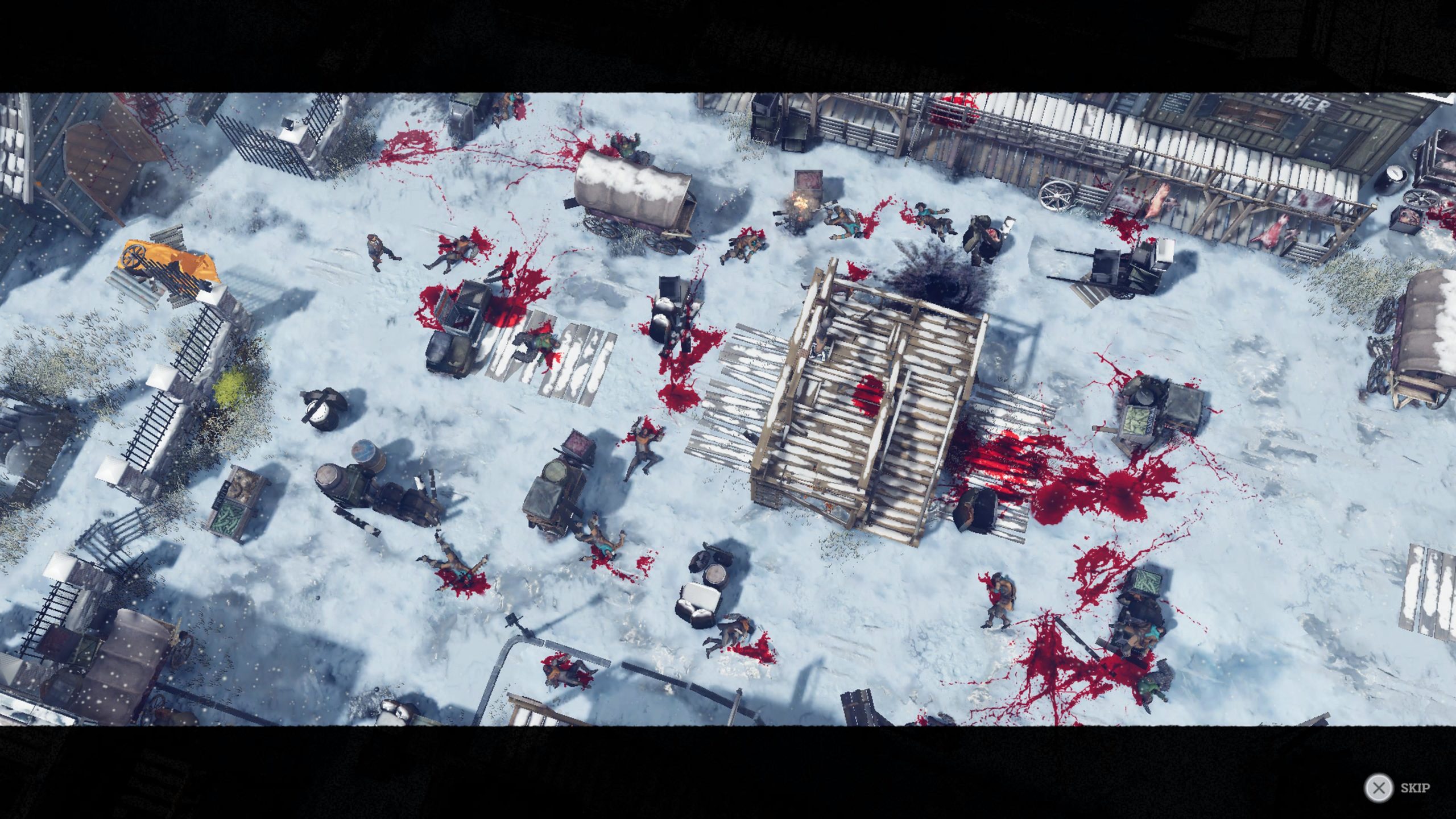
Combat was refreshingly quick, mostly due to the Bravado kill streaks. Weaker fodder enemies could be hoovered up fairly simply, leaving more strategy and consideration for the tougher types, and bullet sponges. Overall, I did find the UI fairly cluttered, but there’s a necessity to knowing as much as possible on the battlefield, and I certainly used it all at least a bit. One really useful feature of the UI was that when hovering over squares choosing where to move to, the accuracy of your shot on enemies in range will be displayed, helping you choose the perfect position.
I found the combat levels in large part to be far too long. With little money to buy bandages and such, the long 20-30 minute shootouts were hard to get through with one set of health. And worst of all, reaching near the end of one of these only to fall, and find that even with a nice save you were virtually never going to win the battle, was a massive drain on enjoyment. I would have preferred far more abilities based around healing for levels this long, or shorter levels with harder enemies. Either way, the balance presented was the harder end of the scale on all fronts.
Lastly, it’s almost impossible to get stronger. I barely found any system geared to actually levelling up the characters or enhancing things in a meaningful way. You have some cards you can find that will give small, barely noticeable increases in speed or +3 health etc. The luck system made little appreciable difference to my success or failure, no matter how much I experimented turning it on or off.
Comanche Moon
Hard West II is a dark game. I don’t mean because every other human you encounter is either undead or actively trying to skin you, although that’s true. It’s more that plunging your world into perpetual winter and an unforgiving fog of war makes every last level and all exploration feel like I have plumbed the very depths of the available shades of blue grey.
There is some nice art, plenty of detailed character work and NPCs, and the world looks good throughout. It’s just that I can barely see it most of the time. Take a snowy township, add darkness, and then add over that the greying of seeing through multiple floors, and you will start to see what I mean.
Though I had to read far more than I had anticipated going in, there was a fairly good amount of voice work and most of it done to a good standard. No character stands out as badly done, but conversely little of it claws its way above serviceable.
I enjoyed some of the nicely appropriate soundtrack, and much of it has a fairly ominous or foreboding feel. On the plus side, even when you were hearing the same music over and over during a long tense battle, it fell away into the unfocussed ambiance.
The Good, The Bad and The Ugly
There are still a variety of glitches and a few oversights in the console release. Enemies can disappear from the map, and then reappear a few turns later; the inputs can lag in deciding when they want to take notice of your commands, or when cycling through options; and there were a few remaining keyboard letter commands left over from the PC release. None of these can’t be fixed with a judicious patch, but they are there currently.
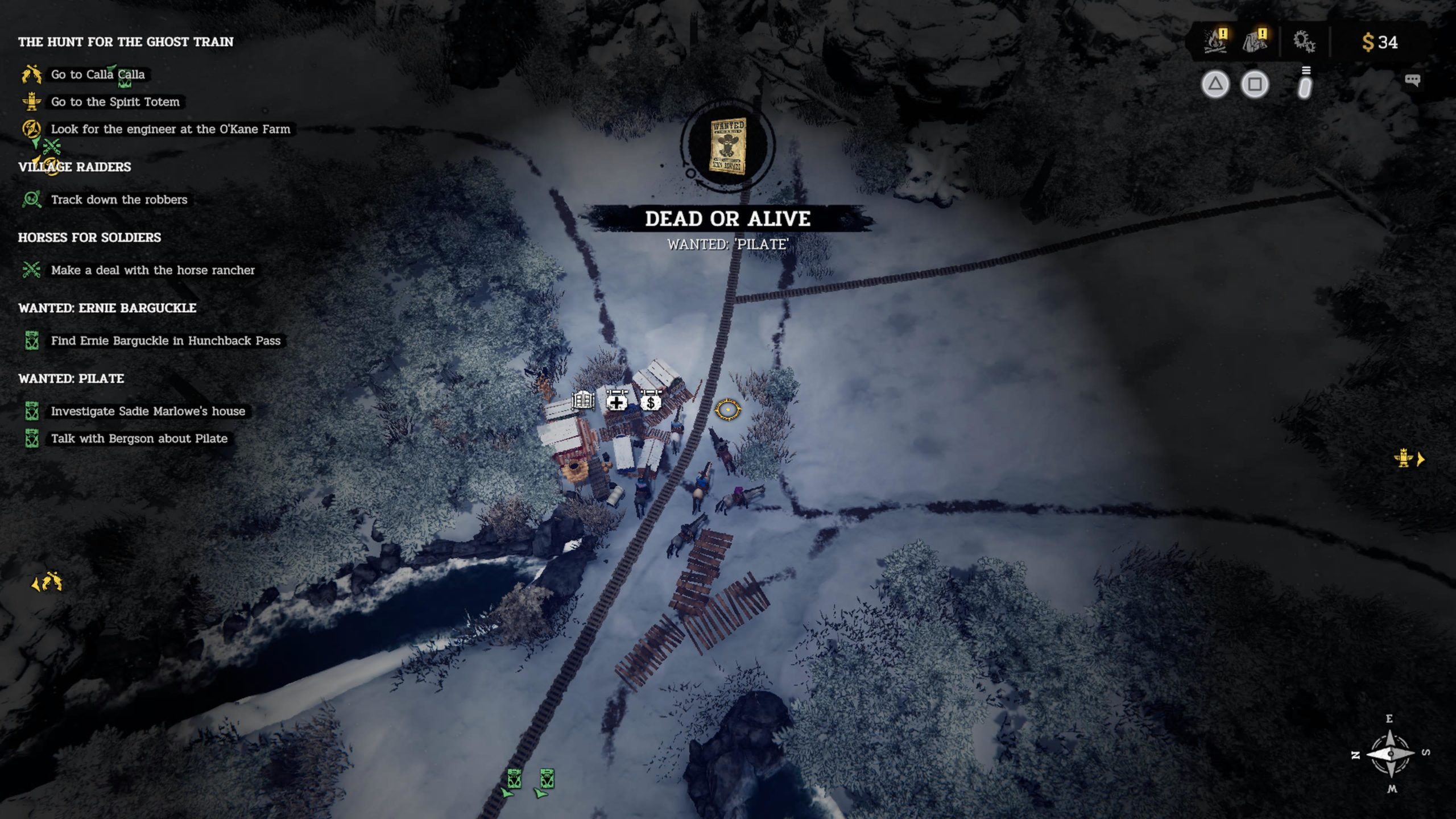
UI remained an issue for me throughout. Apart from the clutter and the lack of menus you might expect to find, there’s no menu to track quests, clues or information. Instead, the UI is further cluttered, listing every last quest you have open along the left-hand side of the screen (a very PC design idea) and the point in the quest you have reached. Often a quest would run out of icons to tell you where to go next, but you had no way of re-reading the clues at the small homesteads that might have held information you missed.
I also found the difficulty spikes on the default level (Hard as in Hard West) were quite tough, and I played a fair bit of this for review on the ‘normal’ difficulty level. Like, why play on hard mode just because it’s default? I didn’t like how the harder the game got, the more its unique qualities fell away – for example, Bravado hardly works when the enemies can take more than a few shots to kill. Ricochets become worthless when enemies barely feel it. And hard mode became a slog of using all four posse members to take out a single enemy, and get a single bravado to carry over. I ended up using all my gold just healing the team all the time. The balance is far more manageable on normal as you would expect.
Blood Meridian
So, we’ve driven the undead all the way across Oregon and caught a Ghost Train back. Hard West II is one tough son of a gun. However, my trouble was less with the undead and more with the lack of any kind of real progression system, the bleak and repetitive atmosphere of the world and presentation, and the lack of much in the way of reward or incentive to keep playing. I became disenchanted very fast, and found the exploration monotonous and bleak. I didn’t look forward to playing. Between the long levels, the lack of rewards, and the bleak atmosphere, it is a fairly depressing experience.
Hard West II is out now on PlayStation 5 (review platform) and Xbox Series X/S, and was released in 2022 on PC via Steam.
Developer: Ice Code Games
Publisher: Good Shepherd Entertainment
Disclaimer: In order to complete this review, we were provided with a promotional copy of the game. For our full review policy, please go here.
If you enjoyed this article or any more of our content, please consider our Patreon.
Make sure to follow Finger Guns on our social channels –Twitter, Facebook, Twitch, Spotify or Apple Podcasts – to keep up to date on our news, reviews and features.