
We’ve had a roguelite in almost every genre at this point, so it was only a matter of time until the contractually necessary pinball roguelite. I’m not even sure it’s the first one, but it’s the first one I’ve played. Appulse also smashes some analog stick shooter in there for good measure, which I have never seen in a pinball game. I am not complaining; I love pinball games even when they are just single-deck freeware running on your old Windows 95 PC, but when you add multiple decks, multiple missions, runs, analog stick shooting, and roguelite progression systems, you’re on to something incredible. Let’s look closer at those synergies.
Cross-Departmental Synergies
Pinball games aren’t known for their narratives, and Appulse had no real business having a story, nor being as sassy and funny as it is. But regardless of the pinball, there’s a well-scripted background to this multiball action. You’re a flipper-control drone called T1-LT working for Elias Vektor, a multibillionaire arms manufacturer bent on patenting, sorry, finding a new Earth for humanity, and taking on the Iron Accord robotic enemies of our species in the way of that dream. He’s outfitted his warships with closed-loop kinetic economy pinball, in order to fight, and do so without incurring unmanageable cost.
The script is what I want to point out here. Elias Vektor is a corporate-party-line and buzzword-spewing maniac, and I had a lot of fun listening to the well-delivered lines throughout the game. The story is only basic really, but the fact that it’s there at all is really fun, and gave the game another layer of depth. Really not much depth, but a little.
Closed-Loop Kinetic Economy
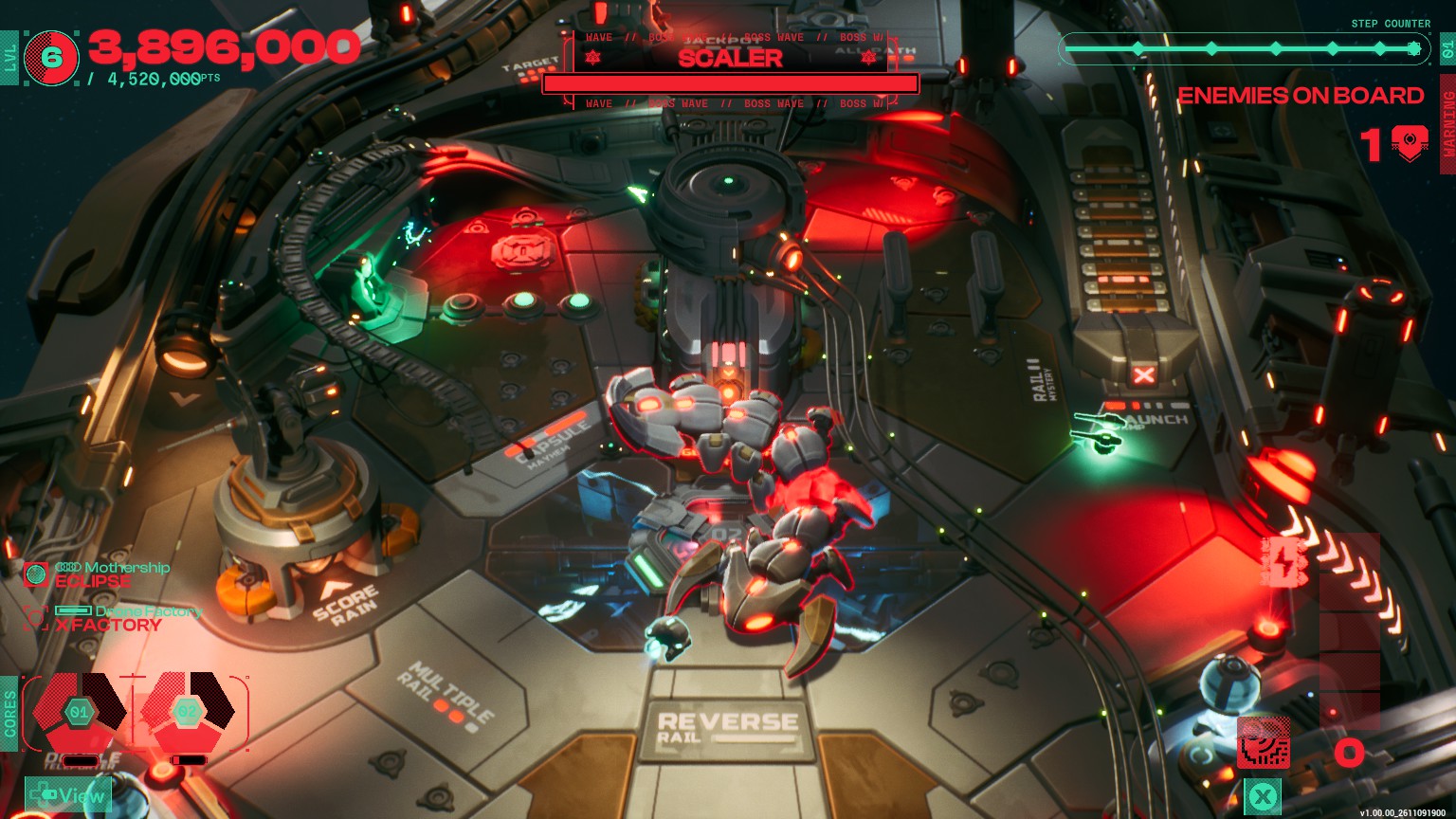
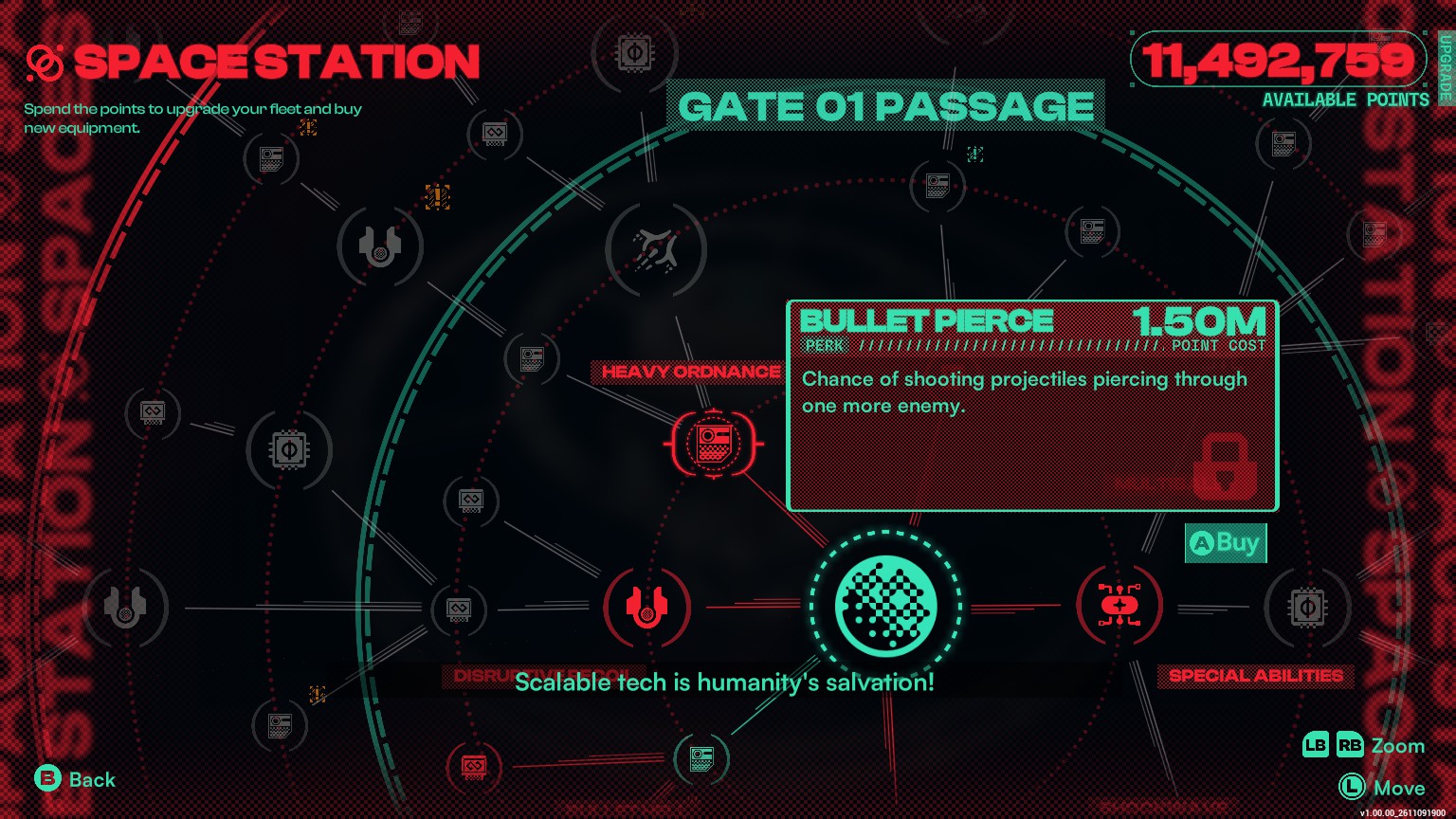
Your prowess at pinball and, in turn, at shooting the enemies that attack, will determine how far you progress in the war against the metal horde of the Iron Accord. Enemy drones flood into your pinball mothership deck and attack your core, which usually has three sections that can fail before the whole mothership explodes, and it’s run over. But don’t worry, this is a roguelite; use all the points you accumulated hitting all the bumpers and ramps, and killing all the enemies, to purchase permanent upgrades for your mothership and ball loadout, and come back stronger. These could be a variety of different weapons, multiballs, perks like enemy-piercing bullets, or greater recoil, and health or armor upgrades for the mothership cores. There’s plenty of variety, and like Hades, these perks appear during play as a three-option pop-ups when you get enough points.
Between runs, there are a few tiers to the permanent upgrade screen, one of which requires you to beat two bosses and get to the second gate. This proved quite the challenge, certainly getting me to the 6-hour mark or so all on its own. The great thing about breaching that though, is you get access to virtually all the rest of the upgrades, and two more mothership decks to add to your fleet, for a total of four. Plus I think five different mid-run upgrade shuttle decks. The mothership ones make reaching the final stages much easier with each iteration, mainly because you go from one core to defend, to two, to three or four. And while that’s multiplying the access for enemies to tear into the ship like squiddies from the Matrix, it also represents that much more time for you to survive.
Ballistic-Assisted Manoeuvring
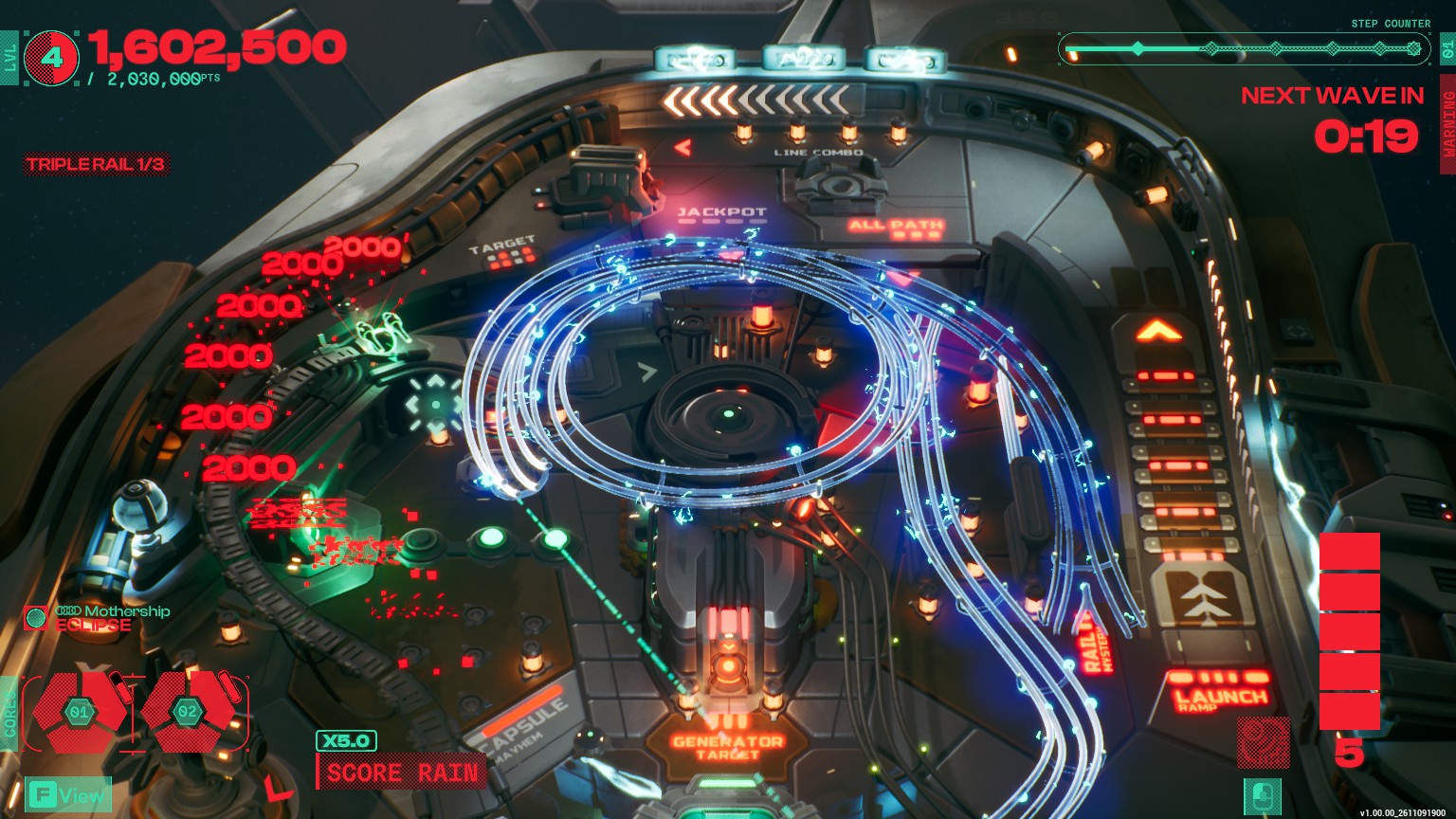
One really fun emergent idea from the cross-department synergy of putting an analog stick shooter inside a pinball deck is that shooting in one direction produces recoil in the other. As you use your gun to shoot and use the stick to aim, you are shooting in the direction of the enemy but moving in the opposite direction due to the recoil. As Elias Vektor likes to call it, it’s ballistic-assisted manoeuvring. In pinball, this is a bit of a game changer. Instead of only being reliant on the accuracy (or luck, let’s be honest) of your flipper hits, you can recoil-shoot yourself into the rails, ramps and bumpers for more points.
It takes practice to think backwards. I mean it takes practice to even use a shooter in the midst of a pinball deck and not forget to then use your flippers. But speaking of the recoil mechanic specifically – with time, you can direct your ball deftly into maximising scores and taking full advantage of decks and their many routes and score multipliers.
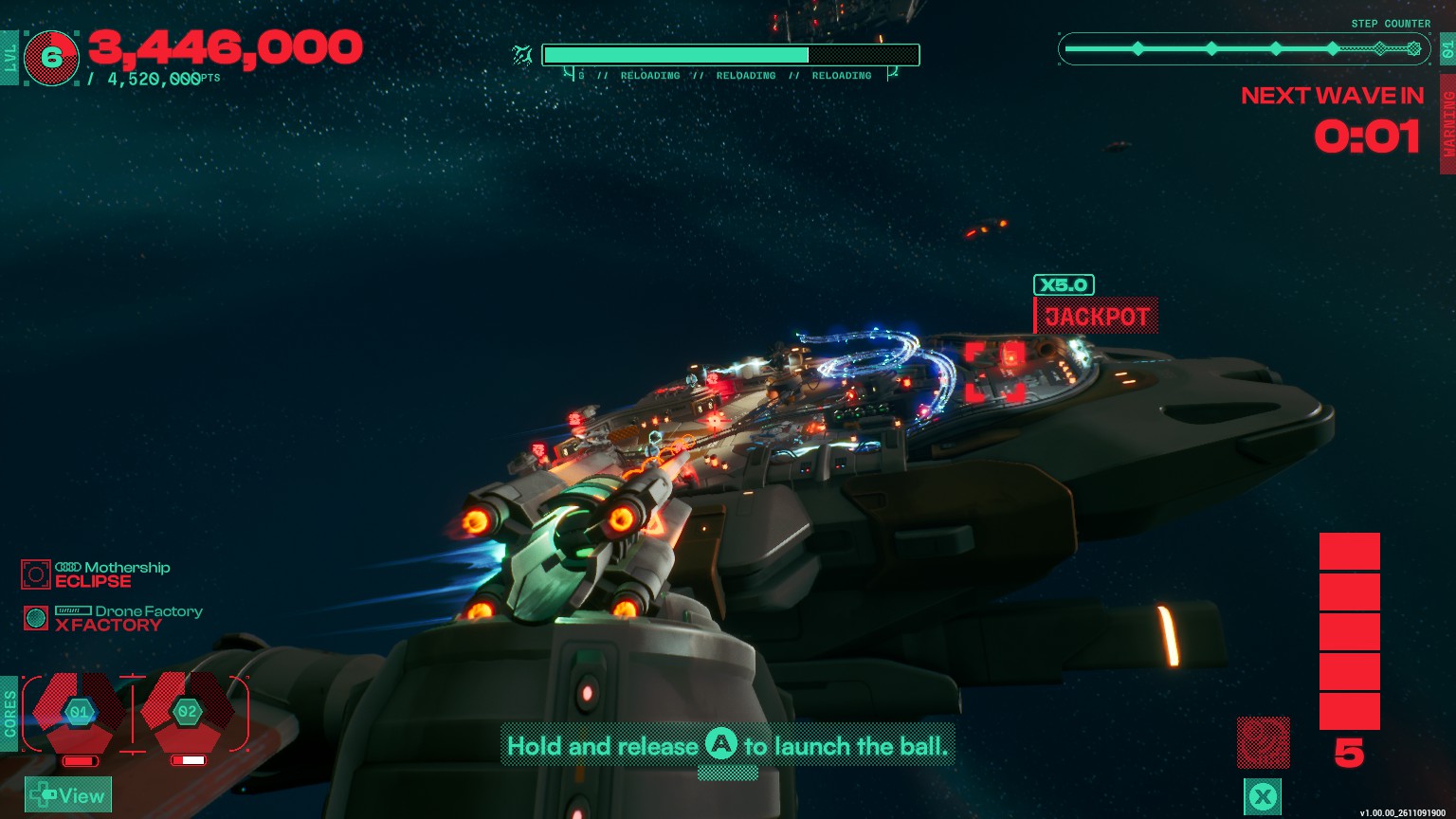
This being a spaceship, rather than just a pinball deck, there’s a variety of things to hit that perform interesting functions. One mothership deck has a missile loader on the side that you can load up and then set off to dramatic effect on an enemy wave. The next has a stunner pillar in the centre. You can hit a pinball shooter and then aim in 3D at a shuttle, which is essentially another quick pinball deck, to earn perks or health packs for your mothership.
You’re The Disruptive Asset
Let’s talk enemy waves before we move on. Like many roguelites, enemies invade the mothership in waves, and you have to use your accumulated skills and perks to take them out before they destroy the ship. This is definitely where the challenge of the game appears, because even with a lot of practice, I’m not the most accurate with my flippers. I’m mostly trying to keep the ball in play more than I am good at targeting particular areas. Therefore hitting enemies quickly became incredibly stressful in short bursts. It’s hair-tearingly frustrating to shoot the ball around the top area of the deck while the enemies are tearing open the core in the bottom section. I could miss and miss, over and over, and just be watching my core health drop.
And even with the gun, which of course you can use to help shoot the enemies, it’s still often hard to get those last ones, at awkward angles. I found it really hard to rewire my brain to think that I could recoil into enemies easier than I could shoot them, and move away from them. Using a shorter range but powerful shotgun, meant needing to use this mechanic more, whereas using a long-range rail gun gave fantastic shooting accuracy, but needed to be heavily buffed for recoil as its starting stats were so low.
Either way, there’s plenty of room for experimentation with the different firearms and how they play, and how they demand you play in different ways. You’ll find your preferred one, just as I did. Personally, it was long-distance weapons and less of the recoil.
Pin Ball Pit
Appulse is possibly the prettiest pinball game I’ve ever seen. From the mothership itself and all the glowing pulsing multipliers, to the constantly moving parts, and even the deeply hidden pistons attached to your flippers, everything is moving and everything is dynamic. There’s never really a static scene in the whole game. I really liked the glitchy metallic soundtrack, very fitting for the action, although it’s a short game so there weren’t loads of tracks.
Appulse is the pinball roguelite of your dreams. Polished and balanced progression and gameplay, gorgeous graphics and movement, dozens of fun perks and permanent upgrades to make each run a little different and add to that sweet replayability. Adding a science fiction kind of backdrop to all the action, setting the pinball on the deck of a spaceship, infinite reprinted balls, and superb attention to detail all meant that Appulse was uncommonly good. Full Disclosure: That was actually awesome.
Appulse is out on 26th November 2026 on PC via Steam (review platform).
Developer: Le Rado
Publisher: Raw Fury
Disclaimer: In order to complete this review, we were provided with a promotional copy of the game. For our full review policy, please go here.
If you enjoyed this article or any more of our content, please consider our Patreon.
Make sure to follow Finger Guns on our social channels –Twitter, Facebook, Twitch, Spotify or Apple Podcasts – to keep up to date on our news, reviews and features.