Concept Destruction Review (PS5) – Twisted Cardboard Redux

The PS5 version of Concept Destruction runs far smoother than its last-gen counterpart but it’s still cardboard thin. The Finger Guns Review.

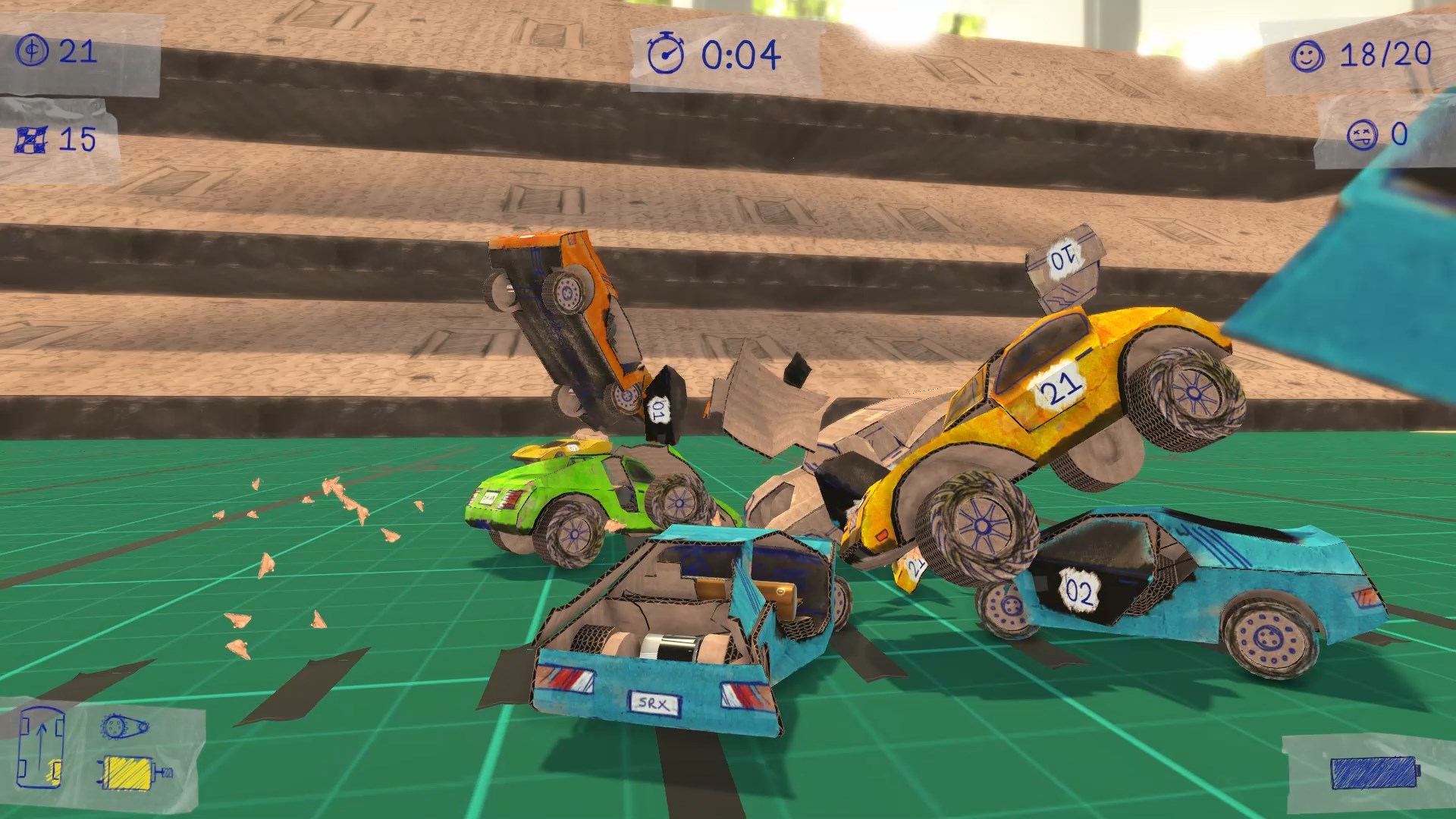
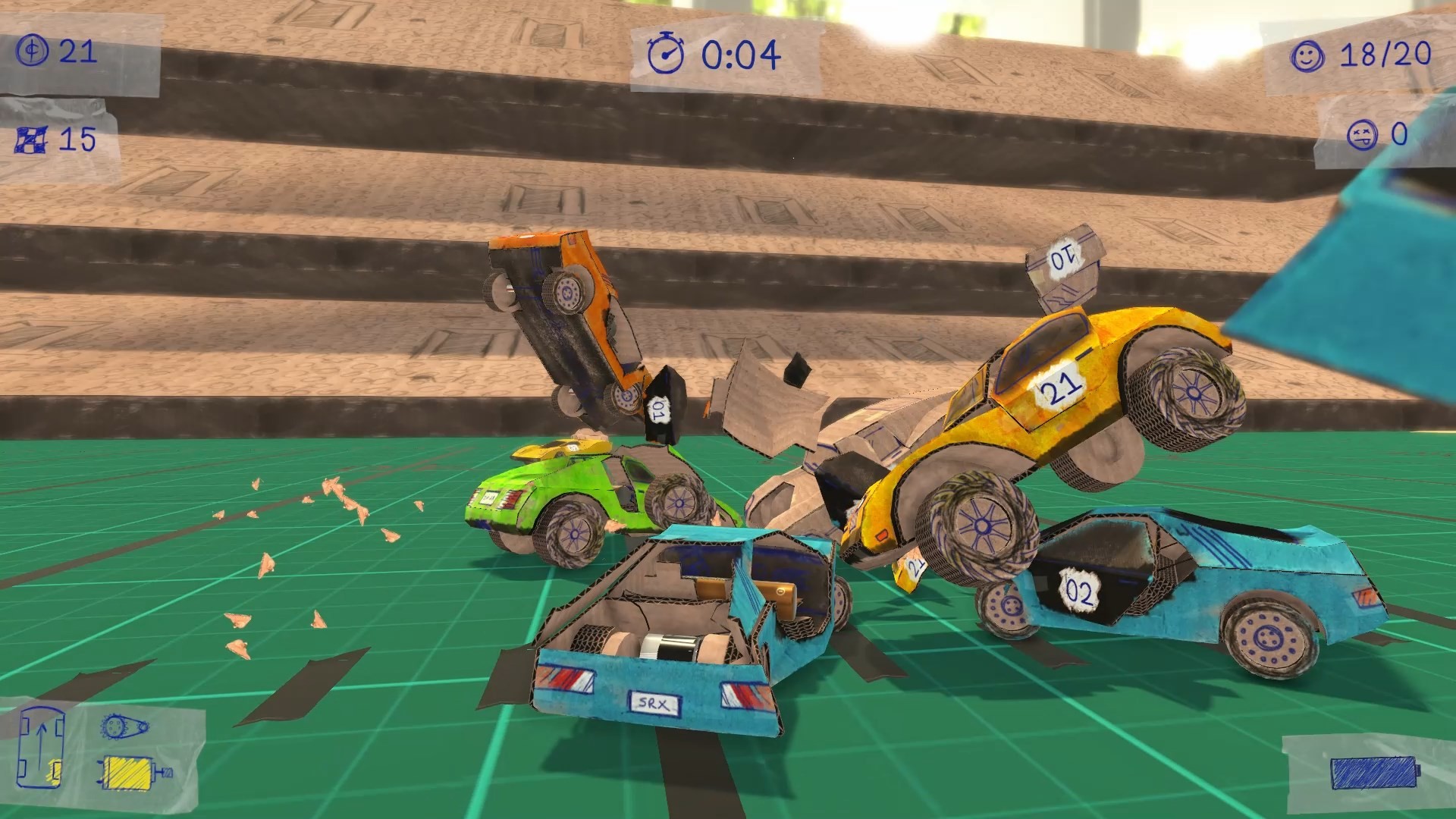
I wondered how long it would take for Ratalaika to begin their conquest for PS5 domination. Easily the most prolific publisher on PS4, they specialise in bringing budget games with unique hooks and easy to obtain Platinum trophies/achievements to consoles. I got my answer with the arrival of the PS5 version of Concept Destruction, just 2 weeks into the PS5’s worldwide existence. Free as an upgrade for those that bought the game on PS4, this racing game is a novel take on the Destruction Derby formula. It puts the player in the tiny driving seat of cardboard vehicles and challenges them to ram the 49 other vehicles to smithereens while avoiding the same fate. It’s easy to pick up, easy to play but quickly becomes tiresome.

The aim with Concept Destruction is to drive into the weak spots of the other 49 cardboard vehicles to do damage which will grant the player with dollar rewards – so long as you’re either the last car standing or you survive until the time runs out for the round. Get destroyed (or destroy yourself by driving into things) and you’ll have to restart that race from scratch.

When I reviewed Concept Destruction back in May for the PS4, I described it as “instantly accessible and a neat take on the Destruction Derby”, but “there’s some odd rules that can cause a headache” and “there’s not a lot of content”. None of that has changed with the PS5 version. The PS5 “upgrade” here is purely cosmetic and the same issues I detailed in May still exist.

Concept Destruction certainly does look much better on the PS5. The cardboard cars look far crisper on the next-gen machine in 4K, as do the environments. The added resolution brings with it some interesting side effects though. For example, the smoke effect that’s pour out of broken down cars look far less convincing in 4K, like chunks of cotton wool floating into the sky rather than a convincing stream of smoke.

Concept Destruction Review PS5

The frame rate on the PS5 version of Concept Destruction is higher too, hitting a steady 60 frames per second during a lot of play, which gives the game a much smoother feeling when driving. Even on the PS5 though, the frame rate can take a nose dive during some modes, especially during the Survival mode. In this mode, all of the other 49 cars in the game home in on the player. When you’ve got this many cars on screen and they’re all ramming into one spot, the frame rate hits single digits per second.

Concept Destruction doesn’t really utilise the DualSense controller in any meaningful way. The haptic feedback, triggered when the players’ car crashes into other cars/environment or when parts of the car start to drag on the floor, is a basic rumble on par with what exists on the PS4 via the DualShock 4. It’s just a shake with no dynamic feel to it. Concept Destruction makes no use of the trigger tension either.

None of these mild improvements make the issues with Concept Destruction any more palatable. While the moment to moment gameplay is still fun, the structure of the game which forces players to waste time simply staying alive rather than enjoying the chaos, is still frustrating. Matches feel too long and it’s not uncommon that after a quick altercation with a traffic jam of other cardboard cars, it can leave the player desperately trying to stay alive for 3 whole minuets rather than actually enjoying the game.

Concept Destruction Review PS5 3

There’s still a lack of content in Concept Destruction. The main campaign mode encourages repetition across the games small variety of levels. The first play through will unlock better cars to enable higher scores which in turn unlocks better cars. The issue here is that if you play the game even moderately well, you’ll only need a single play through to unlock all of the cars. There’s a total of 2 hours worth of content here, discounting the 2 player multiplayer which adds a little more replayability.

While native PS5 experiences are still in short supply, Concept Destruction is there to make up the numbers and little more than that. The improvements over the PS4 version are minimal and beyond getting a quick Platinum trophy, there’s virtually no reason to download the PS5 edition of this game if you’ve played the PS4 version.


For new players, Concept Destruction on PS5 will provide 2 hours of no frills car smashing before it gets dry. The structure of the game, emphasising survival rather than the cathartic crashing, feels at odds with the fun the game can deliver elsewhere. For PS4 players, the upgrade here can barely be described as such and beyond an easy Platinum Trophy, is hardly worth a download.

Concept Destruction is available now on PS5 (version reviewed), PS4 Xbox One, PC and Nintendo Switch.

Developer: Thinice
Publisher: Ratalaika Games

Disclaimer: In order to complete this review, we purchased a copy of the game. For our full review policy, please go here.

If you enjoyed this article or any more of our content, please consider our Patreon.

Clash Force (PS4) Review – Not-Quite-Mega-Men

Another day, another retro inspired game that’s trying to recreate the magic that some games had 20 years ago. This time it’s Clash Force, a run and gun platformer that wears its NES shooter inspirations like Mega Man on its sleeve. Unfortunately, some questionable design decisions and a few dull boss battles mean that Clash Force never gets close to the games its trying to emulate.

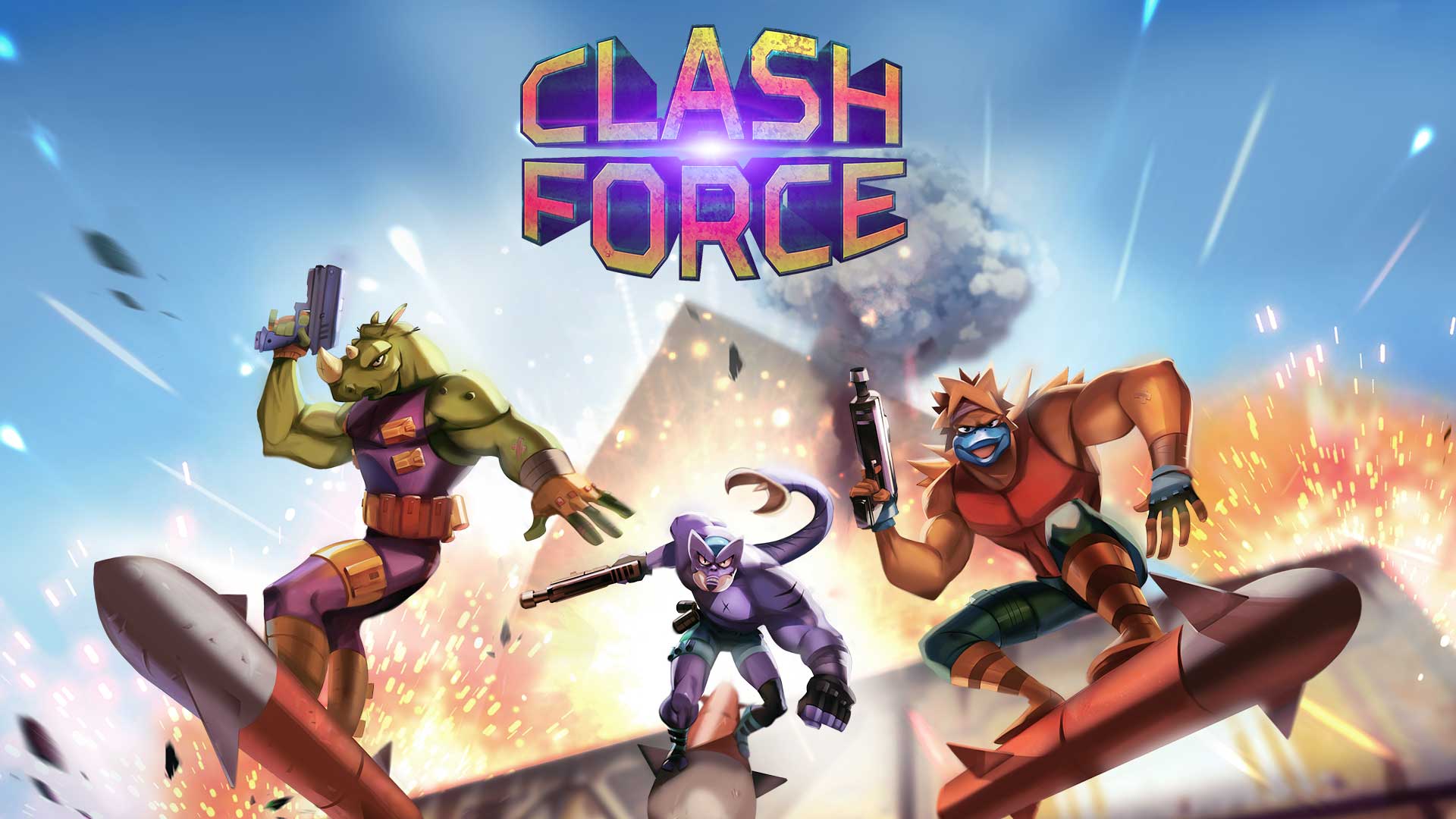
A villain called Crackman (no, seriously) and his army of robotic minions are attacking and the only team who can stop him are the Clash Force. A trio of gun toting anthropomorphic characters – Voom a rhino, Scorpido a scorpion and Echid an echidna – they set off to stop Crackman. The differences with each Clash Force team member is purely cosmetic. There’s no difference in the way any of the trio play.

Clash Force is a traditional 2D platforming run and gunner. Each level is set from left to right and you move along, shooting down everything in your path in order to reach the exit door. You have 3 heart’s which represent your health and when you lose all 3 or fall into an instant death pit, it’s back to the start of the current mission. The trio of heroes can jump higher the longer you hold down the jump button and they can only fire forward – there’s no 8-directional fire here. Just left and right. As you progress, you can collect power up’s which change your weapon from a single shot into multiple shots from 2 to 5 blasts. These power-up’s are lost when you take damage. There’s also shields which prevent one damage dealing hit to your Clash Force operative.

Clash Force 1

In order to defeat Crackman, you’ll need to take you Clash Force fighter through several biomes across 21 levels including 6 boss battles. Each location – Forest, Underground, Fortress, Desert and finally Crackman’s flying base – has a different visual aesthetic and introduces new enemy types to fight against. An impressive element of this structure is that not only does each biome have its own visual look, each level within that area also has subtle differences. This is complemented by a brilliant soundtrack that has the same feel as being from the NES chiptune era but is modernised with far more range and instruments. The soundtrack matches each location incredibly well putting a subtle twist on the stereotypical tunes from the location. For example, the Desert track has a guitar riff you’d expect to hear in any Wild West flick but it’s sped up and backed by a synth track full of pomp and circumstance.

Clash Force Screenshot 2

It’s the design of Clash Force that’s a little lacklustre. The game is only a few hours long and aside from some of the later boss battles and a handful of set piece levels – a level in the desert that has you travel on a raft and a moving platform level Underground being the most impressive – Clash Force feels mundane and far too simple. It’s missing those tense moments that would have your feet twitching and butt clenching from the Mega Man games. This is partly because of the structure of the game – only having to complete one level at a time and death just means restarting that level which encourages repetition – and partly because the game is so forgiving. For example, it’s possible to cheese through the first 2 boss battles of the game by standing in a single spot and pressing the fire button when Crackman lowers himself to your area. The late game certainly makes up for the early trudge but the real test is whether your patience will last that long.

It’s hard not to admire the goal of Clash Force. Releasing a Mega Man inspired shooter in 2020, even sticking to the 4:3 aspect ratio and adorning the wide screen sides with images of the main characters, is bold. This game is obviously a labour of love for Spicy Gyro Games. That said, compared to it’s peers in an era when we have retro inspired titles that are actually pushing the genre forward, it doesn’t do enough to look anything other than a pale imitation of the original’s its trying to emulate.

Clash Force is available now on PS4 (Review Platform), Xbox One, PC and Nintendo Switch.

Developer: Spicy Gyro Games
Publisher: Ratalaika Games

Disclaimer: In order to complete this review, a copy of the game was purchased. For our full review policy, please go here.

If you enjoyed this article or any more of our content, please consider our Patreon.

Make sure to follow Finger Guns on our social channels –TwitterFacebookTwitchSpotify or Apple Podcasts – to keep up to date on our news, reviews and features.

Concept Destruction (PS4) Review – Twisted Cardboard

I think it’s fair to say that Ratalaika are the most prolific publisher on the PS4 at this point. It feels like there’s not a week that goes by that doesn’t see a budget game published by them onto the PSN Store. The latest, Concept Destruction, released this week and it’s a novel take on Demolition Derby.

The hook here is that your cars are made of cardboard. When you boot up the game you’re treated by an intro video of a concept artist dreaming up vehicles made of cardboard. So, it happens. He builds them, you drive them, they collide and get destroyed. It’s a no-nonsense, no frills concept.

Literal Table Top Gaming

Set on table top stages that have obstacles like pens, coke cans, scissors and even a pizza box with a few leftover slices, the idea behind each event is to survive while doing as much damage as possible to your opponents. Once the lights turn green, the whole field of cars go at it, smashing into one another.

Concept Destruction Pizza

There’s some fun yet very unrealistic physics in Concept Destruction that relate to the car damage. The cardboard vehicles will dent, concertina, cave in and fall to pieces as you crash into one another. Each ding you take effects how your car handles. Lose a wheel and turning at speed can flip you over. Lose 2 wheels and you might as well be the Titanic trying to avoid that iceberg. Get mashed up while still keeping your battery and engine in tact and you can end up just limping around an arena unable to do anything other than wait for someone to finally smash you to pieces.

Concept Destruction Crash

To win each event in Concept Destruction, you have to either be the last car standing or have done more damage to the pack than anyone else when the timer runs out. In the competition mode, you’ve got to win a series of events. Strangely, there’s no second place here. You either win or you’ve forced to restart the event you failed until you do win.

This can be a tad frustrating as the AI is erratic and events can be chaotic. This isn’t a game that requires skill and no matter how good you are at driving games, it won’t help here. A win can come as simply as watching your last 2 competitors drive off a table together. A loss can come – repeatedly – 30 seconds into an event as you get crushed by the entire pack. This is especially true when your first and only unlocked car is as sturdy as a wet paper bag.

Concept Destruction Destroyed

A better selection of vehicles are unlocked as you achieve better high scores in the competition mode. A better car means the ability to achieve higher scores which in turn unlocks even better vehicles. Each car has their strengths and weaknesses and handling of their own. It’s a nice little loop but it does make for repetitive play. You’re competing on the same tracks over and over – more often if you fail – and the novelty of the game play wears off quickly because of it.

Then there’s some very odd failure conditions too. You can lose an event if you stop moving or don’t hit another car for a period of time. I understand the reasoning behind these rules – without them you could just park up in a safe space and wait until the AI cars kill each other then swoop in for the win. The issue here though is that if your cardboard vehicle gets utterly trashed and your opponents aren’t in much better shape, you can fail by simply not having the juice to bump into one another. When you’ve lost 2 wheels, and the only opponent left also looks like someone suplexed an Amazon delivery into a car crusher and they’re a long way away, it’s easy to lose this way purely because getting to one another slows to a snails pace. There probably needed to be systems in place to recognise when you’re simply unable to smash and bash or, even better, better incentive staying in the action (maybe by repairing a little of your vehicle if you total an opponent). Instead, it’s possible to take out half the field of cars and then lose on a technicality.

There’s another little niggle too – the respawning. When you’re upside down, you can right yourself with the left thumbstick. Doing so opens your boot, trunk and doors to flip you. If you’ve lost all of these in a crash, the game just respawns you the right way up. The kicker? It does it to all the opponents too. The respawn sets you a little above the ground too so as you appear, you fall a little. I lost count of the number of times I was bearing down on a car on its side ready to jacknife them in half only for them to respawn in the air, for me to drive under them and collide with a wall.

Visually, Concept Destruction is basic but it does a good enough job convincing the player that they’re competing on a table top arena made of cardboard and tools. As your car gets damaged, some of the models have weird physics glitches where you’ll see the wheels coming through the wings of the car and the likes. It’s probably the price you pay for having an extensive damage type like that in the game.

Once you’ve played the single player content for 1-2 hours, you’ll have seen everything Concept Destruction has to offer. Thankfully there’s a local 2 player split-screen mode here which will add a little more longevity to the game.

In need of recycling?

Concept Destruction is instantly accessible a neat take on the Destruction Derby set on table tops with cardboard cars. There’s some odd rules that can cause a headache and there’s not a lot of content here. After a few hours, you’ll have seen everything the game has under the hood. The local 2-player mode is welcome but the game is crying out for an online battle mode. It won’t be challenging Wreckfest for its crown but if you’re looking for a few hours of brainless crashing and bashing on a budget, you’ll find it here.

5/10

Concept Destruction is available now on PS4 (version reviewed), Xbox One, PC and Nintendo Switch.

Developer: Thinice
Publisher: Ratalaika Games

Disclaimer: In order to complete this review, we purchased a copy of the game. For our full review policy, please go here.

If you enjoyed this article or any more of our content, please consider our Patreon.

Super Destronaut: Land Wars Review – Shoot, Shoot, Shoot, Repeat

A total re-invention of a series, Super Destronaut: Land Wars is a retro styled FPS that’s light on variety and heavy on style. The Finger Guns Review;

Petite Games really are the masters of game dev recycling. I mean that as a complement. A few years ago they transformed a procedurally generated platformer, 36 Fragments of Midnight, a game I described as “thoroughly uninteresting”, into a “surprisingly enjoyable” 2D golf game called Midnight Deluxe. It was a fantastic transformation. Now, they’ve done it again with Super Destronaut DX, a Space Invaders game, taking the villains and building them into a retro themed FPS called Super Destronaut: Land Wars.

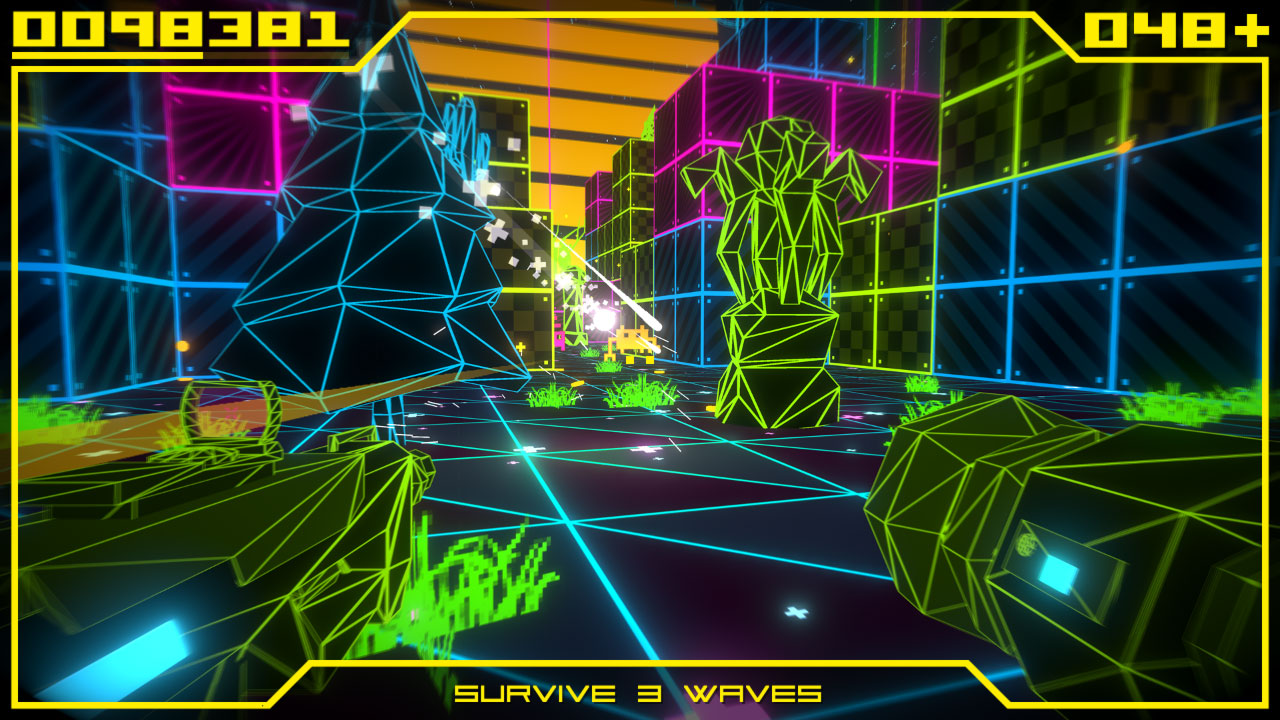
Super Destronaut: Land Wars has all the staples of a 90’s styled FPS game. It’s low res with a dubstep soundtrack, pointy angles everywhere and flat weapon sounds. The only unique aspect here is that it looks like Tron had a baby with a christmas tree. Outlined wire frames in garish hues make up the environment, mostly blocks of walls but in some of the maps, there’s trees and small pieces of scenery. It’s an eye catching art style that, combined with the soundtrack, makes for a heady and interesting feel.

Compared to the art style, the rest of Super Destronaut: Land Wars is a bare bones mechanical experience. There’s only a handful of arena’s to do battle in and all of them are basically a square path with some points of interest that keep you from getting lost in its repetitive corridors. There’s 5 weapons to unlock and use but the starter assault rifle is just as useful as the final and most expensive rocket launcher. Occasionally, and seemingly at random, you’ll equip 2 weapons and a Rampage will begin. As fun as that is, there’s no rhyme or rhythm to when they come so it’s hard to utilise them properly. There’s no look down sight option. The player can jump, but there’s absolutely no verticality to the levels in the game, making the feature almost useless.

In the original Super Destronaut game, the Space Invaders-esque enemies flew into the top of the screen and you blast them from there – but here, they spawn in groups around a small map and then hop around the level firing projectiles in your direction. The models themselves are identical to those found in its predecessor which makes for some impressive recycling because they don’t seem out of place here.

On the surface, it looks as though there’s quite a lot of content in Super Destronaut: Land Wars. A Challenge mode, made up of tonnes of individual tests, A basic arcade, a hardcore more (basically a more difficult arcade mode), slug mode that removes the player jump and a hand full others.

Unfortunately, within an hour of play, you see that all of this content is skin deep only. Take the challenge mode. Each of these challenges has a criteria – Kill X enemies, Collect Y Coins, Buy Z weapon from the in-game shop. Survive a certain amount of time. Boiled down into their component parts, they are all just about shooting things. Kill X enemies. Obviously, by shooting them. Collect Y coins…by shooting the aliens and picking up the coins they leave behind. Buy Z weapon…by shooting enemies, picking up the coins they leave behind then spending them at the weapon shop. Survive…by shooting things. There’s an admirable amount of smoke and mirrors here to make it appear that Super Destronaut: Land Wars has any depth when this game is a real one trick pony with levels that last just a few moments each.

And that’s not necessarily a bad thing for a budget game like this. Super Destronaut: Land Wars costs a few quid on the PS4 and there’s enough variety and a few hours of longevity to justify that price. This is a slight improvement on Petite Games’ last FPS outing Bouncy Bullets, at least in terms of concept and execution, at least.

The re-invention of Super Destronaut as a retro inspired FPS doesn’t work quite as well as it did for the redesign of Fragments of Midnight. Still, Petite Games have managed to expand a clone of Space Invaders into an IP that now has entries into multiple genres. There’s a cool art style here, with a pumping soundtrack that’ll have you tapping your foot until you get bored of everything else this game lacks. It’s that lack of content that hampers Super Destronaut: Land Wars in the long run, with all manner of goals unconvincingly re-badged as more than just “shoot things” which just won’t keep you entertained for long.

Oh and, it’s a Ratalaika game so of course there’s an easy Platinum trophy.


Super Destronaut: Land Wars is available now on PS4 (reviewed), Xbox One, Nintendo Switch, Pc and PSVita.

Developer: Petite Games
Publisher: Ratalaika Games

Disclaimer: In order to complete this review, we purchased a copy of the game. For our full review policy, please go here.

If you enjoyed this article or any more of our content, please consider our Patreon.

Syrup and the Ultimate Sweet (PS4) Review – Short and Sweets

A visual novel that’s sometimes sickly, Syrup and the Ultimate Sweet is a short treat that’s worth a look if you’re a fan of the genre. The Finger Guns Review;

For someone who’s not a massive fan of visual novel games, I’ve sure played a lot of them. Whether it’s escaping numbered death mazes, being trapped on a tropical island with a murderous teddy bear or using a time travelling microwave to alter the past, I’ve become quite accustomed to the oddities that this genre can throw at you. 

What I wasn’t quite ready for was a nude candy-golem saying the words “Please eat me. I bet I taste great” to a woman she’d just met. 

That’s a staple of Syrup and the Ultimate Sweet, a game by NomnomNami and an entry into the lesbian-centric game jam Yuri Jam 2015. It’s never explicit, and seems to coat it’s queerness in layer upon layer of cuteness until it feels like those moments live in between the lines of dialogue rather than directly in them. Still, this game lives up to the brief of the game jam and tells a charming, if occasionally sickly story that’s got a colourful cast of characters.

Syrup, the main character of this story, is an alchemist who’s one focus in life is making the very best candy she can in her lab. She sells her creations in her shop, Candy Altier, which is run by her friend and confident Pastille. This shop sells the best candy because Syrup uses alchemy rather than magic to make her sweets. One day, a full sized candy-golem, a walking and talking collection of sucrose in female form, appears in Syrup’s lab and attempts to befriend her. Eventually taking the name Gumdrop, this golem is the focus of a branching narrative that goes to some weird and wonderful places. This whole paragraph is the litmus test on whether you’ll like this game or not – if that sounded like I was plastering a diabetic fever dream all over your screen, you won’t enjoy this game one iota beyond an easy Platinum trophy. Still here? Okay then.

This game contains all of the staples of the visual novel genre and is played out almost entirely through conversation, either with other characters or as Syrup talking to herself. Characters will show up, they’ll take to the right or left of the screen and their words will appear at the bottom of the screen accompanied by the occasional sound effect. Every so often, you’ll have to make a decision between 2 to 4 choices that appear on screen. Syrup and the Ultimate Sweet has 9 endings you can unlock through exploring these decisions and what the consequences of your choices are. Maybe when Gumdrop arrives in your lab, you let Syrup indulge the golem’s request and let her chow down? Maybe you’re wary of where this candy-golem came from and try to track down her origins, perhaps leading to an old rival, a witch by the name of Butterscotch? While there’s some repetition in every playthrough (thankfully there’s an Auto function and you can skip scenes you’ve seen before) there’s enough originality to keep a player entertained for an hour or 2. 

And that’s the main drawback with Syrup and the Ultimate Sweet. Before you know it, it’s over, even on the longest of the story paths. It most definitely shows itself as a product of a game jam with time limits in the regard but the game probably lasts just long enough not to outstay its welcome. 

The art work employed throughout Syrup and the Ultimate Sweet is really quite charming. It has this anime X western saturday morning cartoon feel to it that’s certainly unique and something I’ll be looking forward to seeing more of in the future. The backgrounds, pencil lined and pale, offer a lot of juxtaposition to the bold and colourful characters too, really making them pop. This is all underpinned by a soundtrack, provided by Mock Off, that compliments each scene admirably.

It feels like I’m bordering on insane by saying the following about a game that’s about a candy-golem that’s begging to be eaten but there’s a few curious moments in the story of Syrup and the Ultimate Sweet which hinder it a little. There’s a set of characters, the Chocolate twins, that are introduced and despite having a grand entrance, don’t seem to have an effect on the story. Their inclusion feels odd and they feel underused compared to other characters. Elsewhere, some of the character motivations seem to swing wildly based on small decisions – this is likely so that the endings could be quite different from one another but it makes the game feel a tad inconsistent. 

Nitpicking aside, Syrup and the Ultimate Sweet is a fun 2 hour journey through a branching narrative with plenty of queer representation if you go looking for it that will, if you’ve made it this far in the review without shutting the browser, likely raise a smile or two.

It’s a cheap and cheerful title and while it’s not going to be challenging the giants of the genre in terms of narrative or immersion, it has enough charm to carry itself through its run time.


Syrup and the Ultimate Sweet is available now on PS4 (reviewed), Xbox One, Nintendo Switch, Pc and Mobile devices.

Developer: NomnomNima
Publisher: Ratalaika Games

Disclaimer: In order to complete this review, we purchased a copy of the game. For our full review policy, please go here.

If you enjoyed this article or any more of our content, please consider our Patreon.

Sagebrush (PS4) Review – Cult Classic

Sagebrush on PS4 is a quick Platinum, but thankfully a deeper resonance will keep your attention to the end. The Finger Guns Review;

On a whim and browsing the PSN Store I came across Sagebrush, a brand new title priced at £4.99. Ever the curious person I had a nose at the synopsis and the trailer, immediately drawn in by its interesting, rather unsettling premise. It was only a week ago that I reviewed another game that told the story of a cult and I had hopes that Sagebrush could provide a more nuanced and personable take on a storytelling device that I find particularly interesting. Ergo, I purchased the game and two hours later, the game was complete and I had a brand new Platinum to add to the collection. Allow me to tell you all about Sagebrush.

Cults in video games are nothing new. They’re always an interesting subject of my favourite stories across any medium (Far Cry 5, The Wicker Man, The Handmaids Tale) and whilst most take you out of your busy, straightforward live and place you directly in the midst of their compounds, Sagebrush has you arriving at the setting of this particular cult some years after its rather grisly demise. It’s far more Everybody’s Gone to the Rapture than The Church in the Darkness, and you can jump into this game being very, very thankful of that.

You’re tasked with exploring the compound known as Black Sage Ranch, home of the Perfect Heaven Millennial cult. You have the entire ranch to explore and search for clues about those that chose to be part of the flock that lived here, and what led to their mass-suicide. You’re completely alone, searching for knowledge of those that gave up everything to worship at the church of Father James, a deeply troubled and sinister character whose harrowing story unravels throughout the playthrough.

To learn about the cult you can freely explore any area of the ranch, but you’ll soon realise that you have to slowly unpick everything in a particular order, recollecting memories through tape recordings and written notes. Reading timetables in various places and piecing together information you’ve gathered in order for you to progress. There are small puzzles where you’ll read a note that says, for example ‘the day I found the truth is the code’, and it’s then up to you to find out what he means, the code of which I found in the compounds school on the wall on the timetable of communions (‘A Celebration of the First Day). Dotted around each area the game is ever-so slightly nudging you towards is the clue for your next movement. You do have a map if you get lost but it’s lacking information, namely just the location of each place (the trailers that the flock lived in, the church, the home of the Father etc…). There were moments where it didn’t quite click what I was supposed to be doing, but a quick run back to where I was before provided the answer. There’s no rush to do anything, so plenty of areas of interest will be locked until it’s time for them to play their part. It never really feels like a slog.

Thankfully, the way Sagebrush invests you into the story was enough for me to keep playing. The biggest draw is how the story unfolds itself throughout your exploration, with the narrative being engaging and tightly focused. A game like Sagebrush just wouldn’t work if the story it told never held your attention, as the story ‘is’ the game much like the aforementioned Rapture, Edith Finch, Gone Home style of gameplay (although thankfully if you want to move a little faster the game actually lets you move much faster which is a huge tick in comparison to similar in its genre).

In each location there are letters and tape recordings that unravel the mindset of some of the flock, trying to understand their place in the cult, why they’re there at all and how they can stand another trip to the ‘Cleansing Room’ (where cult members are physically hurt with canes, removal of body parts, genital mutilation and more to purge their sins).

One of the more fascinating aspects of Perfect Heaven was that this entire cult was built on unpacking the fabrication of traditional religion, reaching out to those who needed meaning in their lives and convincing them that other forms of belief were full of lies. It’s a genuinely interesting strand that I wanted to follow more. I would have played a vastly longer version of Sagebrush if it meant tumbling down that particular rabbit hole. There was enough of it here to justify its existence, and the backstory of Father James kept me gripped enough that I wanted to know more. Someone commission a Netflix series, please?

At times all you’ll need from these letters and recordings are a single sentence to figure out where you should head to next. The puzzle aspect comes in knowing what you should be looking for. The content around them you’ll either find engaging or superfluous. For me it was the former. Perfect Heaven were a small but dedicated cult, despite secretly fearing Father James and discussing this with one another. Reaching the leaders homestead was perhaps my favourite part of the entire game, as it confirmed for me the suspicions of his actions, and made me feel for those who died in his name without knowing what he truly desired.

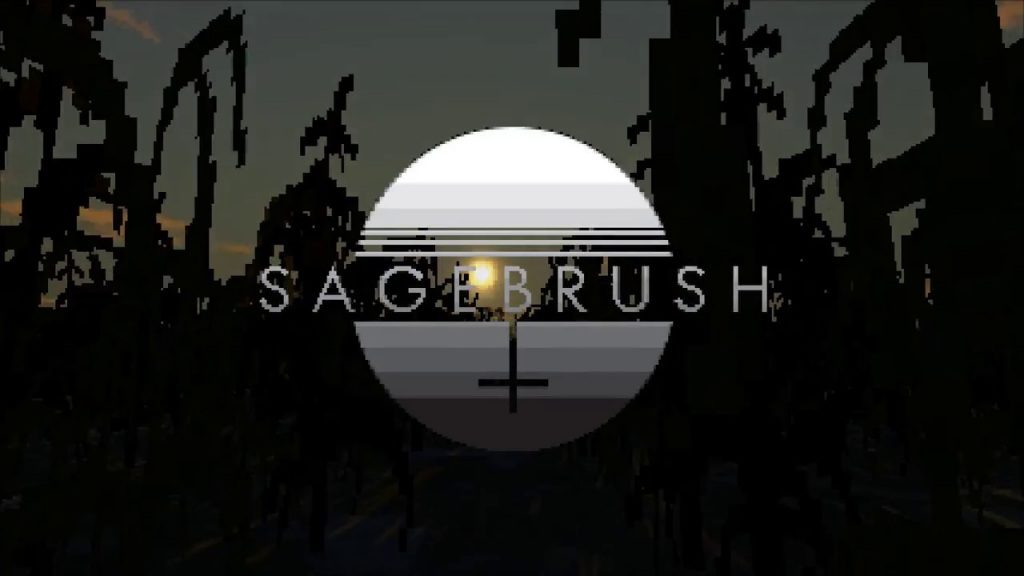
You may have noticed in the screenshots that it looks like what any 3D video game would look like if I was running it on the lowest possible specs on my laptop. Ergo, I finished the game on my PS4 and the low-fi, low-poly visual style is entirely intentional, despite playing just like it belongs in this generation. The visual style was rather delightful, and never got in the way of my enjoyment. Its representation of a quiet, unassuming and ‘no-frills’ world works very well, particularly during the daytime sections. It’s easy enough to decipher what you should be focusing on the game doesn’t allow you to interact with anything you shouldn’t be interacting with. The games soundtrack is minimal but deeply unsettling, adding huge gravitas to particular moments in the game that deserve it. Sagebrush is never scary but it is certainly unsettling, the soundtrack doing most of the heavy lifting in this regard.

Also, doors close behind you and the sound of that happening every time jolted me. I’ve never realised how bloody creepy it is until I played Sagebrush and how rare that is in video games to experience.

I talked to Sean about Sagebrush and his experience with Ratalaika Games (very recently, in fact) was that whilst they offered short play times, they weren’t much more than ‘Platinum fodder’, offering little under the surface other than pleasing those who enjoy Trophy hunting. I feel that Sagebrush is far more than that, and whilst it will appeal to those who like to quickly jump in and add to their collection, it offered me an interesting and ever-evolving story that I thoroughly enjoyed unpacking over my playthrough. Hell, I didn’t even know the game had a Platinum until about halfway through after I checked the Trophy list.

The human experience of being drawn into a cult full of deep, dark secrets and the emotional toll it weighs upon you is front and centre in Sagebrush and that’s what made this two-hour experience stand out to me. The slow pace is entirely purposeful, allowing you to soak up each moment and learn more about those who believed in Father James room to be understood, to be heard and ultimately, to be mourned.


Sagebrush is available now on PC, Xbox One, PS4 (reviewed on PS4 Pro) and Nintendo Switch.

Developer: Nate Berens / Redact Games
Publisher: Ratalaika Games

Disclaimer: In order to complete this review, we purchased a copy of the game. For our full review policy, please go here.

If you enjoyed this article or any more of our content, please consider our Patreon.

Bouncy Bullets Review – Cool Concept, Poor Execution

A unique hook and an easy Platinum trophy aren’t enough to shoot Bouncy Bullets out of mediocrity. The Finger Guns Review;

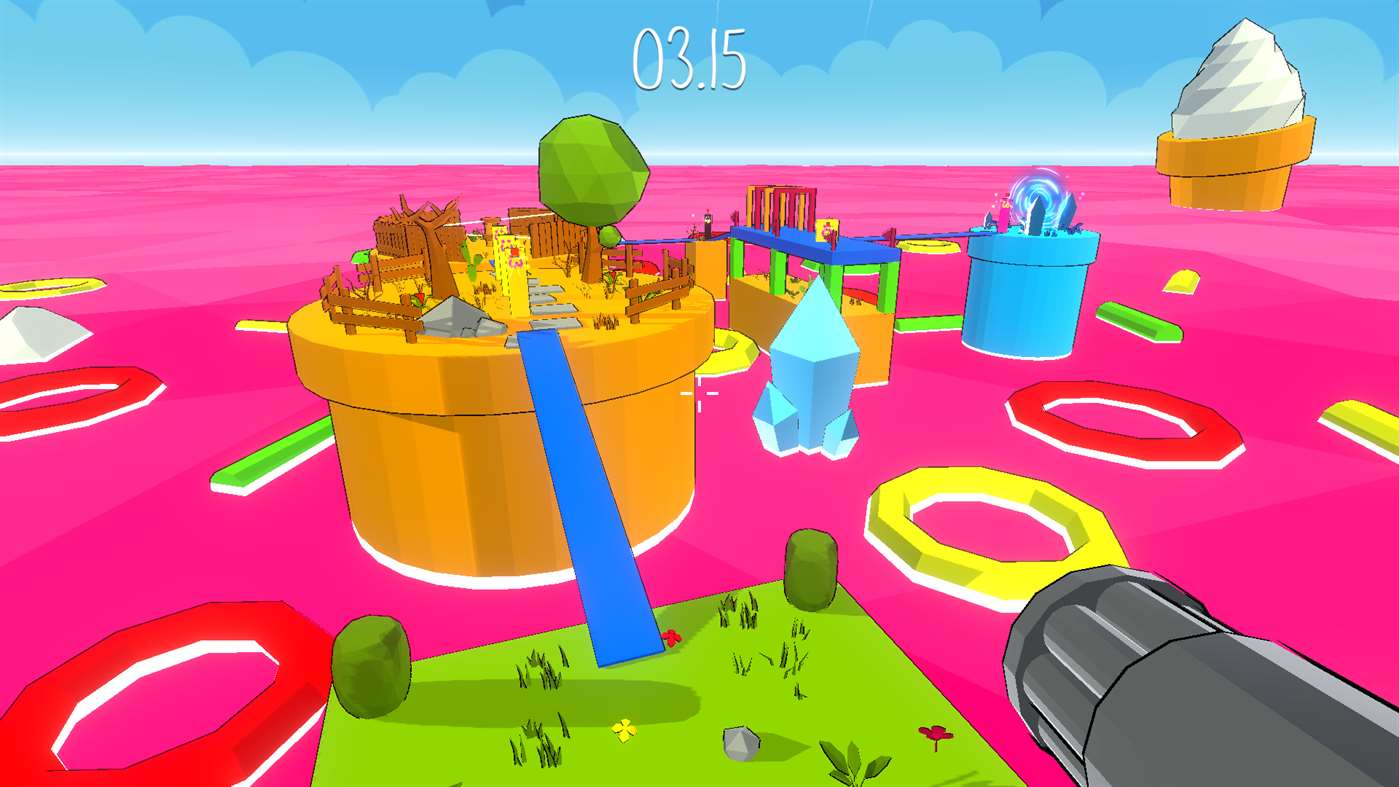
On paper, Bouncy Bullets sounds excellent. A first person platformer – Nice – set in a neon coloured world – Great – where you have a gun that fires pink and yellow bullets – Interesting – at pink and yellow enemies that can only be defeated by a bullet of their corresponding colour – Excellent – as well as black enemies that can only be destroyed by a bullet that has bounced off a surface before hitting them – Brilliant. When reading this description, I was the personification of the “Vince McMahon getting progressively more excited” meme. Unfortunately, the delivery of this concept doesn’t make the most of these idea’s which, coupled with some technical issues, makes for a frustratingly shallow experience.

As described above, Bouncy Bullets is a first person platformer that challenges you to get from the start location to an exit portal across 3 chapters of levels. Standing between you and the way forward are a hand full of pitfalls and obstacles to overcome. Underneath each of the levels in this game is a brightly coloured sea which will force you to restart a level if you touch it so initially, the game just wants you to get from A to B without falling off. To do so is simple enough, it’s just jumping over gaps. Then there’s a stack of pink and yellow blocks that can be shot away with their complementary bullets. Soon enough, spikes and lasers are introduced, raising the difficulty somewhat, as well as bounce pads that launch you into the air (more on those in a second).

Bouncy Bullets

After a few levels, enemies are introduced alongside the most ingenious mechanic in the game. Foes come in a variety of colours and each has to be defeated by using a specific tactic. Pink block enemies have to be shot with a pink bullet (left trigger), yellow enemies have to be shot with a yellow bullet (right trigger), Black enemies can be shot with either bullet but before they land a hit they will have had to have bounced off a surface to kill the enemy. There’s also enemies that cycle between appearing as yellow and pink on a timer and others that require two hits, one pink and one yellow. Lastly, there’s hostages that appear as grey boxes and if they’re hit by any type of bullet, you’re forced to start the level from scratch. As a concept, this is quite unique but unfortately, Bouncing Bullets doesn’t make the most of it.

Each of the standard levels can be completed in under a minute and contain a maximum of 5 enemies. The foes, little more than colourful LEGO bricks with smiley faces on them, are more often than not positioned high on a platform and can be easily picked off. They have no attack pattern or intelligence other than turning to face you and firing off in your direction. They don’t move apart from a little shuffle when they fire (which will occasionally be enough for them to hilariously fall from their perch into the deadly sea below) or have any other moves in their repertoire. They’re just really dumb antagonists that don’t offer much of a challenge. Even the black enemies, those that need a ricochet to kill, are far too sparsely placed and are always in a position that needs no more thought than lowering your crosshair at the floor in front of them to bounce a shot up into their body. Reading the concept, I’d imagined bouncing bullets off walls or around corners but the game really squanders the potential with its design. The most difficult the game gets is when it places Grey hostages next to other enemies so you’ve got to be a little more precise with your shooting and even that’s relatively straight forward.

Bouncing Bullets can be a little masochistic in its design too. One level puts up a wall of pink and yellow blocks at the end of a slim walkway and directly behind it, a grey hostage. It took 3 forced restarts until I’d figured out I’d accidentally shot the hostage behind the wall by shooting through it rather than being shot by an enemy I’d not seen yet. In other sections, grass foliage is put on a platform which also has a set of spikes. The grass makes it difficult to see the spikes and the game knows it too.

Now for those bounce pads. The usual, on-the-ground movement is very responsive in Bouncing Bullets, as is while doing a small jump – but the moment you hit a bounce pad, the game turns to treacle. When flying through the air, the frame rate slows down as to does your movement. This means you’ve got to judge your jumps before taking them and the design of this game often prohibits this by putting the pads on step like platforms.

The soundtrack, a mix of dubstep and trance tracks, are actually very good in Bouncing Bullets. It’s the kind of music that really complements the wacky, colourful atmosphere you’re bombing around in and urges you to press on and be quicker – which is handy because the game judges you on how quickly you complete each level with a 3 star system.

Unfortunately, Bouncing Bullets is over all too quickly. It took me just over an hour to complete all 3 standard chapters of the game. There are then a selection of “Special Stages” to play but this is just a remix of each normal level with more enemies in them. These Special Stages feel like the difficulty the game should have pitched itself as to start with, making a little more use of the core mechanics, but even those pale in comparison to other games in this genre like DeadcoreQUBE2, Valley and Mirrors Edge.

Of course, being a game published by Ratalaika means that Bouncy Bullets comes with an easy Platinum trophy that can be earned by simply playing the game and then a few of the special stages. We’re talking 80 minutes between starting the game and hearing the Plink! of a Plat popping.

Bouncy Bullets is one of Petite Games’ better concepts but it’s a game that doesn’t make full use of its potential with its design. It’s a colourful game with an excellent soundtrack but the frame rate issues when using bounce pads, the thicker than custard AI and the shortness to the game relegate this to yet more Trophy Hunter fodder and little else. A real shame.


Bouncy Bullets is available now on PS4 (review version), PSVita, Xbox One, Nintendo Switch and PC.

Developer: Petite Games
Publisher: Ratalaika Games

In order to complete this review, we purchased a copy of the game. For our full review policy please go here.

If you enjoyed this article or any of our other content please consider supporting our Patreon.

Attack of the Toy Tanks (PSVita) Review – More Like Septic Tank

A shallow and frustrating experience on the PSVita, Attack of the Toy Tanks is a tough recommendation to anyone other than trophy hunters. The Finger Guns Review;

There’s a saying within game development that “No developer ever sets out to make a bad game”. While I’m sure that’s true of all game developers, I’m finding it hard to find that pattern in the titles from Petite Games. 36 Fragments of Midnight, InkSplosion, Super Destronaut DX – Petite Games have been an almost prolific developer this past few years and while they’re managed to create at least one enjoyable game in that time, Attack of the Toy Tanks is not one of them.

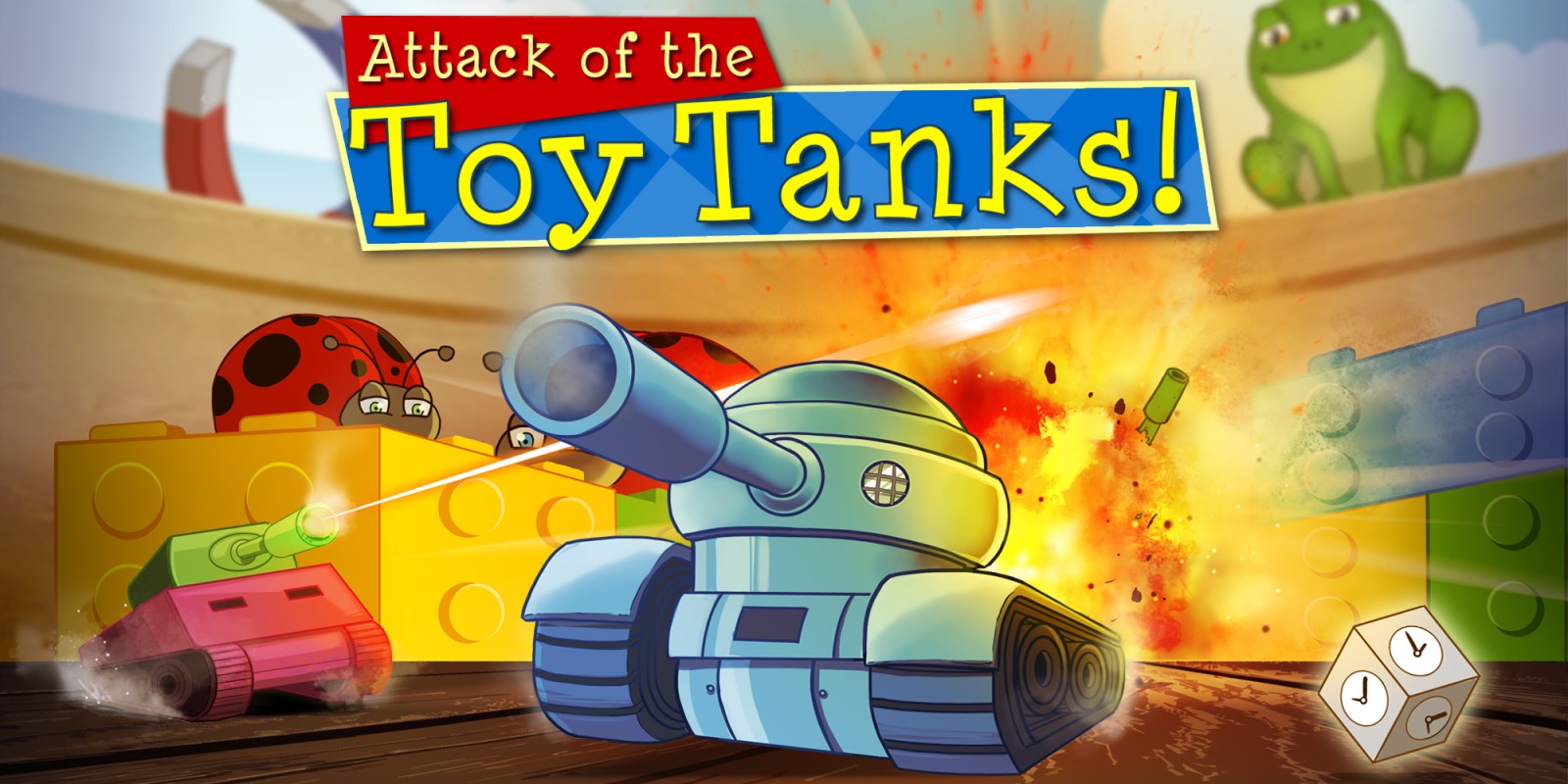
To put it bluntly, Attack of the Toy Tanks feels like what would happen if you look the tank battles from the Mega Drive’s Micro Machines, made them 3D and then sucked all the fun out of them. Set over 60 levels, Toy Tanks has one aim – kill all of other tanks in the arena with your own tanks. A single tank shell is enough to blow them up, but the same applies to you too. This isn’t a battle royale either. None of the AI controlled tanks are friendly and even when you’re facing off against 3 of them, they won’t attack one another. You’re public tank enemy number one and everyone’s gunning for you. You’ll almost always be outnumbered and you’ll always be outgunned against AI enemies that feel telepathic at times.

This game plays kind of like a twin stick shooter but with tank controls throw in for added challenge/confusion. You can only move forward in the direction a small arrow is pointing in a circle around your tank’s base while you can shoot in any 360 degree angle with a target cross-hair indicating which way you’re shooting when the right stick is moved. In each level, you’ll be equipped with a certain type of canon shot which are almost always a straight shot which can travel the entirety of the arena or a bouncing bullet which has a limited range.

Each of the Attack of the Toy Tanks’ 60 levels is a tad different. Some time’s it’ll be 1-vs-1, often times 3-vs-you, but the scenery and dangers always change. Some of the enemy tanks having homing missiles that’ll follow you around corners, for example. Some levels have lasers that’ll track you around the arena or line the walls to restrict your movement. While each arena is different, the scenery is always made up of toys. Building blocks, balls, animal toys. It’s all very on point but also a little bland too. The colour pallet in the game is nicely varied and bright which is offset by mostly dark backgrounds. The PSVita version of the game is demonstrably the poorest of the lot based on screen shots –  lighting effects missing, textures of a far lower texture, edges jagged on the environment and tanks lacking detail.

Even with the uniqueness of each of the arenas, Attack of the Toy Tanks devolves into camping and running away. Because the AI is so accurate, firing off direct hits within a second of seeing you, and with you almost always been outnumbered, the only sure fire tactic of success is to put some scenery between yourself and the enemies and then fire off the very millisecond they come around a corner/come out from cover. A game like this could be fun if the AI made mistakes and give you chances, but these do not.

The difficulty isn’t helped by the fact that tank controls don’t feel at all suitable for the PSVita’s sticks and triggers. You always feel like you need another finger on your right hand to really have control on your tanks, ready to fire, more forward or reverse, all allocated to separate buttons. Thankfully, if you have a PSTV and a Dualshock 4 to hand, it does feel much easier to control leading me to believe this game might be much better on PS4 (for which it is cross buy).

If you’ve come here to find out if Attack of the Toy Tanks is an easy Platinum trophy much like much of Ratalaika‘s back catalogue, then rest assured, it’s another easy one. 70 tank kills and 30 completed levels, less than half the game and just a few hours work, are all it will take to earn you that precious cup and a tonne of gold ones along the way.

Technically though, that might be a problem because 1 in 5 matches I’ve attempted to play in this game have frozen up. Each match of Attack of the Toy Tanks has a countdown start and many matches have just glitched out at ‘3’, forcing a soft close of the game and restart. The game still seems responsive and it doesn’t crash the Vita but it does just freeze up the game play for some reason.

The soundtrack, as varied in quality as it is, might be the best part of this game. Some of the songs in this game sound like they were written as the backing to a new Crazy Frog song but some others really nail that ‘Playing with toy tanks’, mix of military and childhood themes in their tone. The theme changes with each level and the painfully annoying songs are enough motivation to get you through to the next level to hear something more tasteful.

The PSVita version of Attack of the Toy Tanks is missing the 2 player mode of the PS4, has washed out visuals, an occasionally annoying sound track, freezes up at the start of matches, feels difficult to control and has game play which more often than not, devolves into hiding, camping and waiting. This game lacks the spark of excitement that should come with this genre, a spark that has admittedly not been replicated since the 90’s, but if Petite set out to make a good game with Attack of the Toy Tanks, rather than trophy shovel-ware, there’s no evidence of it here.

Attack of the Toy Tanks is available now on PS4, PSVita (review version), Xbox One and Nintendo Switch.

Developer: Petite Games
Publisher: Ratalaika

In order to complete this review, we purchased a copy of the game. For our full review policy please go here.

If you enjoyed this article or any of our other content please consider supporting our Patreon.

Super Destronaut DX Review – Space Imitators

Revitalising a retro gem for modern day audiences isn’t easy. The recent Bubsy revival is testament to that. Still, that’s the task that developers Petite Games (the team behind InkSplosion36 Fragments of Midnight and Midnight Deluxe) have set out for themselves with Super Destronaut DX, a game that’s taking the principles of Space Invaders and is trying to give them a modern day twist.

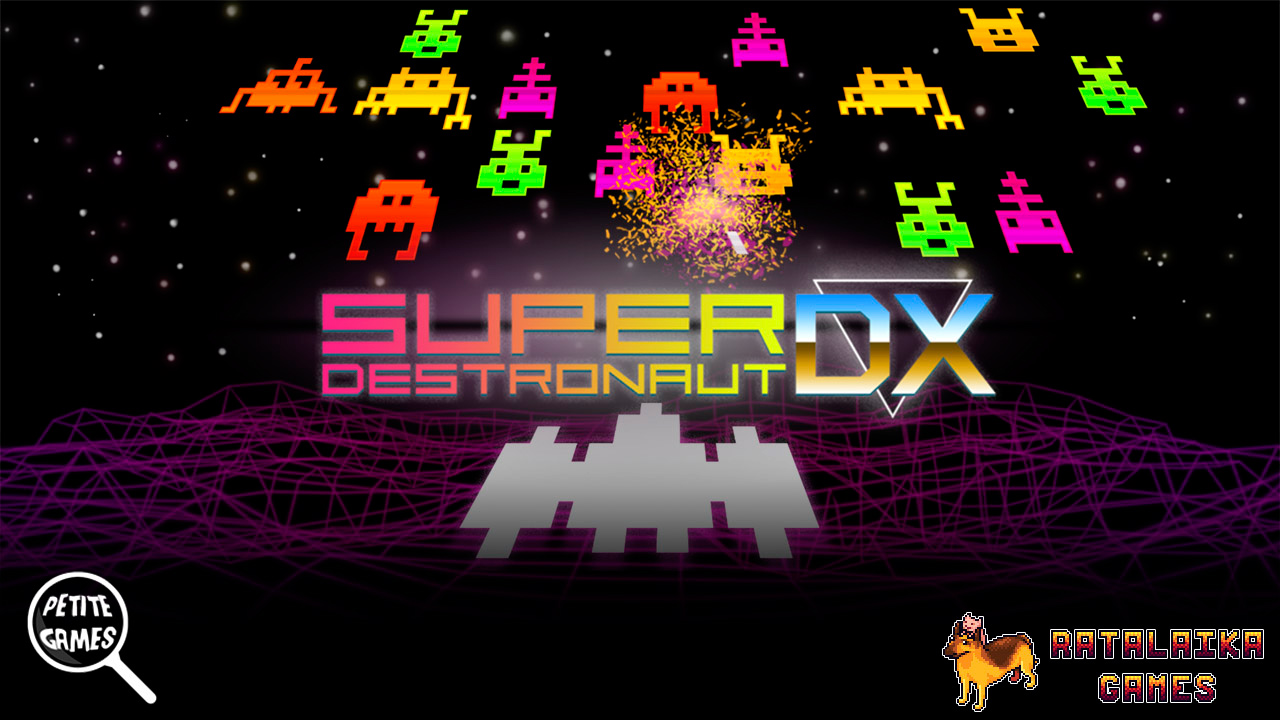
Much like Space Invaders, each match of Super Destronaut DX begins with a wave of enemy aliens patrolling the top of the screen and your own ship moving across the bottom plane. You shoot up at the aliens, moving left and right while avoiding the shots that the aliens are raining down on you. The main difference between Super Destronaut DX and Space Invaders is that the aliens never leave the top of the screen. They don’t proceed any further down the screen the longer they’re alive and they don’t get faster. Instead, this game is about racking up high scores by defeating wave after wave of aliens which respawn each time you destroy them all, adding to your multiplayer with each successful alien destroyed. To add to this subtle difference, on occasion an alien ship, when destroyed, will fall downwards still offering a hazard should they hit you but offers you more points if you shoot them as they descend. On top of this, you’re occasionally granted power-ups which change your weapon to missiles, bombs, triple shots and more when you destroy a special red enemy. The last difference is that Super Destronaut DX adds a 3 dimensional element to the typical 2D gameplay by having invulnerable enemies panning from the background to the players foreground plane meaning that while you’re fighting off the enemies above you, you’ve also got to be careful of those barring your movement.

All blended together, these changes make for a fun, modern take on Space Invaders. There’s nothing new here (Puppy Games got in their first with much of this with Titan Attacks) but this is the first time this has all been wrapped up in a single package. It’s fast fun but unfortunately, Super Destronaut DX lacks any longevity.

Super Destronaut DX is a one trick pony. Once you’ve played a single round of the game in any of the game modes, you’ve seen everything it has to offer. The various alien types cycle in and out but there’s only a handful of formations that they make. Despite the fact that the game has 5 different modes, they’re all virtually the same. Even the Challenge mode, which gives you criteria to hit per test, is nothing more than an playing the same game modes you’ve played elsewhere but in smaller bursts. Everything this game does hinges on its one type of play – shoot the aliens, score points, avoid dying – and the game fails to offer any variety beyond that.

Visually, this title offers a clean and colourful retro inspired aesthetic but it’s hardly a step up from the source material from which it takes its inspiration. As for the audio, there’s a perfectly fine chip tune soundtrack that adequate backs the entire experience while falling short of really providing a ear worm to tap your foot along too. There are some lacklustre vocal sound bites when you unlock power-up’s which made me laugh out loud on the first time of hearing them. They lack the grandiose nature you’d expect to accompany the unlock of missiles or bombs, going in a gentile nature instead. This is akin to watching an ASMR YouTuber whisper “Uzi…Machete…Bazooka”. Frankly, a little odd.

Super Destronaut DX publisher Ratalaika Games know their audience well by this point. Small games with some mild innovations, a small price tag and, the hook, an easy Platinum trophy. That’s what this game provides. There’s an hour or 2 of fun to be had and the small price tag means you probably won’t feel hard done by when the game runs out of things for you to do very quickly. While the innovations Super Destronaut DX bring to the Space Invaders formula are welcome, they don’t go far enough to really bring depth to the package. If you’re looking for a quick boost to your PS4/Vita trophy count, there’s a 30 minute Platinum trophy waiting for you here, otherwise, I’d just stick with the original and best Space Invaders.

Super Destronaut DX is available now on PC, PS4 (reviewed on base PS4), PSVita, Nintendo Switch and Xbox One.

Developers: Petite Games
Publishers: Ratalaika Games

Disclaimer: In order to complete this review, we purchased a copy of the game. For more information, please see our review policy.

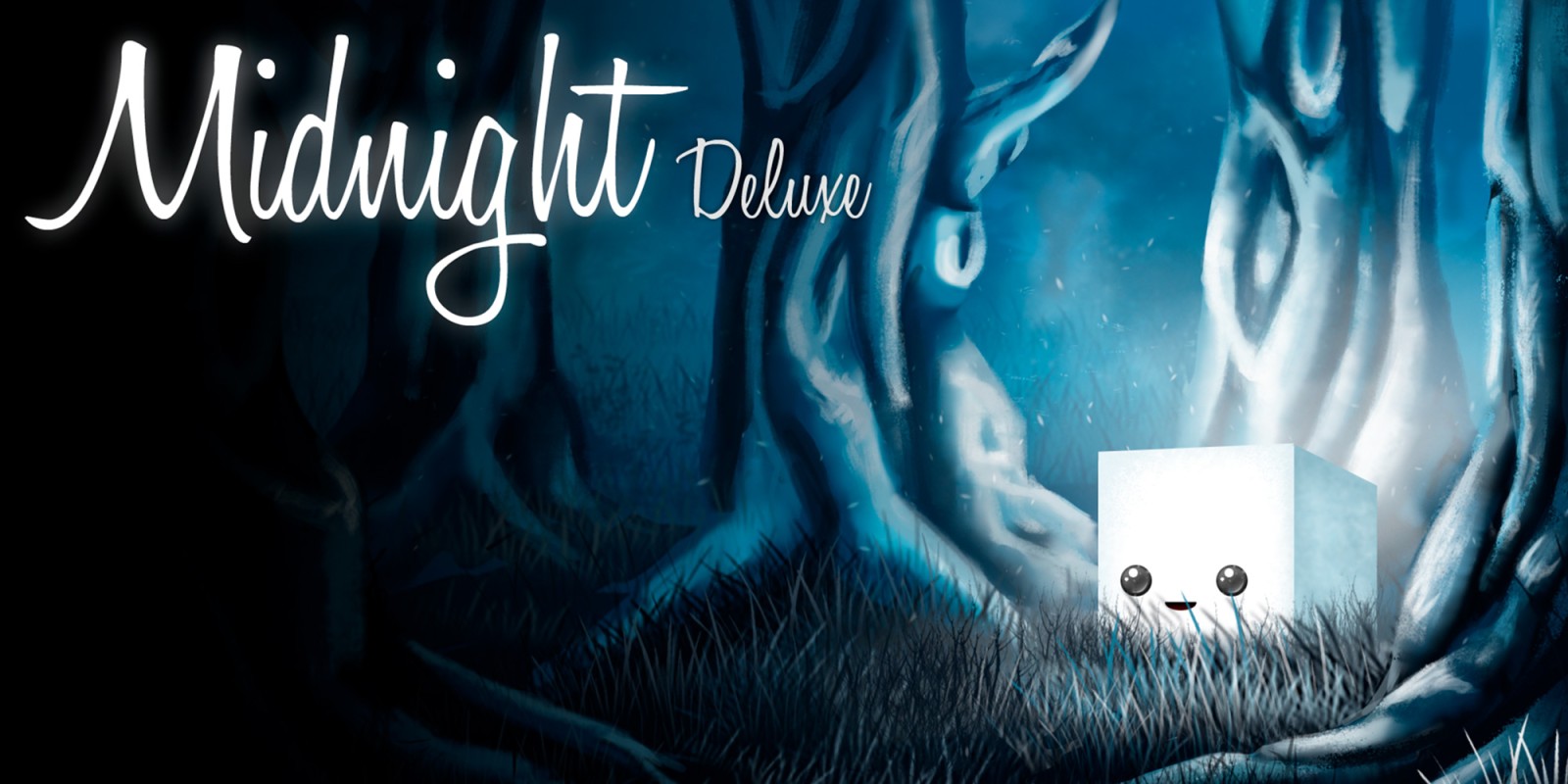
Midnight Deluxe Review – Box Clever Golfing

The smiley glowing box is back and has swapped platforming for golf for Midnight Deluxe. The Finger Guns Review;

I think it’s fair to say that I didn’t enjoy 36 Fragments of Midnight, the last title from Petite Games. I described the short procedurally generated platformer as “bland and thoroughly uninteresting” which “fails to give players any real impetus to dive back in once you’ve completed it once” which can take just 10 minutes. I was surprised then, to see that the little glowing box of a character Midnight back for another game in the shape of “Midnight Deluxe”. What a difference a game type change makes…

In Midnight Deluxe you play as the glowing box of Midnight once again but this time, instead of being a platformer, it’s a golf-adjacent game akin to Desert Golfing. Set across 70 pre-designed levels, the aim is to propel Midnight in to the glowing hole situated somewhere on screen. To do so, you point the Dualshock 4 thumbstick in the direction you want to go, with the force of the stick indicating the power on the shot. Push the thumb stick down to the plastic rim and you’ll propel midnight at the maximum pace. Direct the thumb stick only mildly in a direction and the movement is smaller. There’s a helpful cone that appears outwards from Midnight which displays in which direction and how powerful the movement will be. Once you’re happy, you press X and Midnight is flung through the air in that direction. The game allows you to take as many shots as you need to reach the target so long as you don’t leave the screen or fall foul of the numerous dangers in your way and you’re graded on a three star scale depending on how many shots you’ve taken. The star rating doesn’t bar progress like it does it other similar games which is a nice touch but it does encourage you to do better – when you take two shots to complete a level and you see that it’s possible in one, this drives you to figure out how to get that hole in one.

Reusing all of the assets from 36 Fragments of Midnight, Deluxe fills each of its levels with obstacles and dangers to overcome. Some levels simply challenge you to get from A to B. Others have spinning saw blades lining the floor which will send you back to the starting position should you hit them. There’s one with a timed laser grid which requires millimetre precise moments to get through. Some levels need to be completed quickly before something blocks the only entry into a goal. Each of the game’s 70 levels throws something a little different at you as they get progressively more difficult. There’s the occasional and irritating difficulty spike here and there but none that are insurmountable.

There’s a lovely feel of precision to Midnight Deluxe. The movement of the boxy titular character is anything but natural with its own brand of physics at play. Midnight will glide along some platforms, disobeying the laws of forces that would normally govern a box but this all lends to the needs for accuracy and practice. Some of the 70 levels in this game seem impossible at first until you really get to grips with how Midnight moves, almost self-righting itself to stay level and square.

Because Midnight Deluxe isn’t procedurally generated, Petite Games have managed to give the environments much more personality this time around. The game still has a dark and moody aesthetic but there’s more detail to the landscape with silhouettes of small plants sprouting from the ground and bobbing in the wind. Sure, it’s not the pretties of games but it does what it does well. As Midnight glows, he lights up the area with his shine as he propels through the air. There’s some nice touches to the game as well, like a smile appearing on the faces of the Star Trek tribble-esque friends you can bump into on some levels. There’s an occasional level which looks cobbled together, especially when there’s multiple layers of the same texture stacked on top of one another, but it’s far less offensive than some other games that do this.

The brooding atmosphere is helped enormously by the inclusion of an slow and soft piano soundtrack that complements the “game feel”. Some of the gentle piano chords are incredibly relaxing but I do wish that the soundtrack didn’t reset each time you died or you restart the level. For some of the levels that are filled with dangers, you hardly get through 3 notes before the track restarts because you died.

Midnight Deluxe is a very good example of a developer taking elements of a game that already exists and reworking them into something much better than the original. Almost everything you see on screen will look familiar to those who’ve played 36 Fragments of Midnight but it hardly matters when the game play is so utterly divorced from its predecessor. This is an atmospheric, relaxing and surprisingly enjoyable game about shooting a box into a hole.

Midnight Deluxe is available now on PS4 (review version), Nintendo Switch and PSVita.

Developer: Petite Games
Publisher: Ratalaika Games

Disclaimer: In order to complete this review, we purchased a copy of the game. To find out more, please see our review policy.