

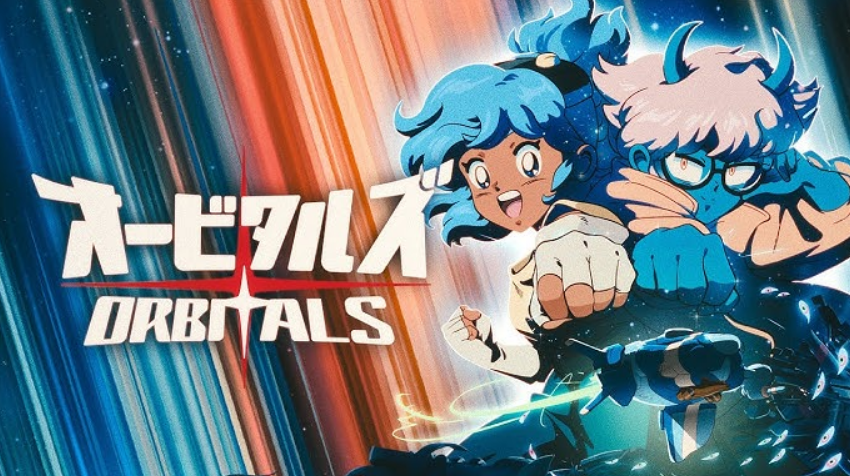
When Orbitals started with an anime sequence that evoked Studio Ghibli, Dragon Ball, Ranma ½, and Evangelion all at once, I knew I was dealing with a studio full of kindred spirits. Anime of today has been ejected out of a convenient nearby airlock in favour of a nostalgic 80s comedy and sci-fi vibe, full of over-the-top animations, cute artwork, and incredibly expressive characters.
Orbitals is an asymmetric cooperative sci-fi adventure where you must work together to solve hundreds of coop challenges. From using different tools at the same time, to shooting and flying your spaceship, to 2D platforming runs, barely a minute goes by where you aren’t problem solving, coordinating, struggling or triumphing. Add to that a drop-dead gorgeous art-style with era-accurate framerates and animation, and Orbitals comes alive, surpassing the sum of its parts.
But platitudes only work in an intro. Let’s work together to delve into the engine and see how this game ticks. You take this Scrap Hook, and I’ll grab the Beam Cannon. To the Airlock!
Have Spacesuit, Will Cooperate
Orbitals is clearly written by a team well versed in classic anime of the 80s and 90s. Everything from that era is being referenced, but at the same time it does not rely on rehashing existing properties. Instead, Orbitals manages to infuse its story and setting with a massive amount of originality, fresh thinking, and rule-breaking. If I had to name a comparison, it’s close to Nausicaa-era Ghibli but in space.
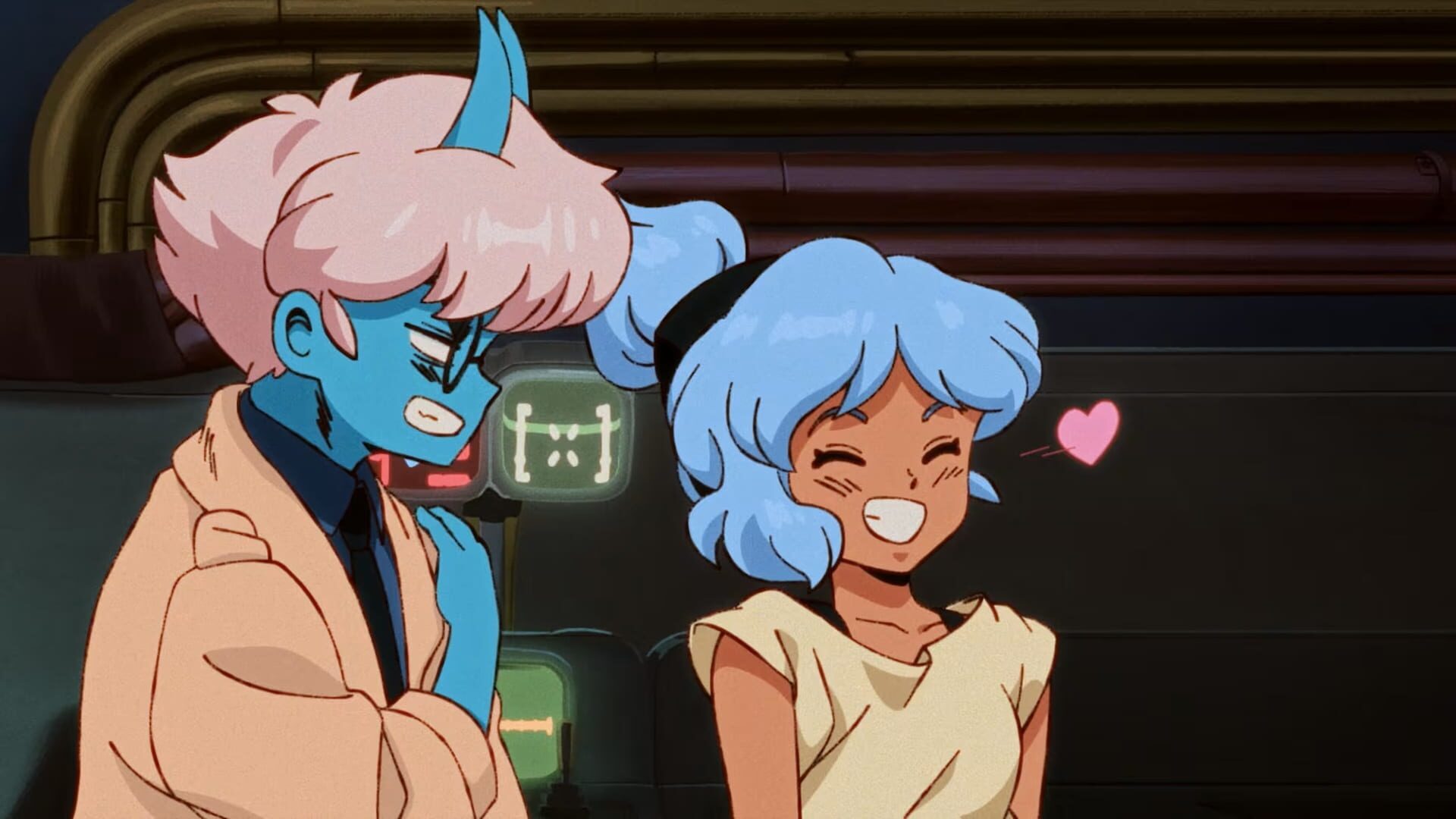
You (and a friend, or sibling, or partner) play as Maki and Omura, two friends whose small spacefaring salvager home gets attacked when they are young, and they are locked behind a great rift in space called the Storm Wall. As children, they are exposed to some kind of technology that gave them close to invulnerability powers, storing their consciousnesses and allowing their bodies to be reprinted if hurt or killed. Useful in a videogame where you’ll die hundreds of times. Now, 15 years later, they are the most able-bodied left on an aging space station full of dumpling-like elderly spacefarers and are needed to perform salvage operations and gather the resources the tiny community needs.
That might all sound very serious, but the two of them are both young and vibrant and funny, and the whole thing is treated as a comedy – they race each other, banter, jibe and play fight constantly. The dialogue, the little innocuous moments of banter, everything has a tight focus towards really fun, often black comedy that actually had me laughing at the oddest moments. Like a little chibi robot suddenly sacrificing its memory core to help you and the awkward silence between Maki and Omura as it dies. Or Omura’s infuriated retorts each time he comes back after Maki blows him up. Or even just their incredibly realistic sighs after a hard boss.
Orbitals leans into the setting and characters much harder than it leans into plot. Apart from that exposition, most of the game is a series of levels built around finding three reactor cassettes to power the community’s broken shields and pass through the rift. There’s some more complexity, a few nice character moments, but that’s the bulk of it plot-wise. While I loved Maki and Omura like a found family by the credits, I lamented that it rarely delved beyond the immediate concerns of gathering resources and powering the shields. Instead of really having any enemy force arrayed against them, Orbitals takes an approach closer to cosy games, where the only real shooting you do is against automated turrets and reprintable robots and drones. There’s a deliberate tone, and a cosy contained feel, that didn’t lend itself to larger questions about the galaxy.
That said, and without spoilers, it does remember its plot right at the end, and the climax is fraught with really interesting philosophical choices, characters on differing sides of major decisions, and epic final moments. It gets real heavy, real fast, for about 15 minutes. But it left me thinking deeply about a few profound questions long after the credits rolled.
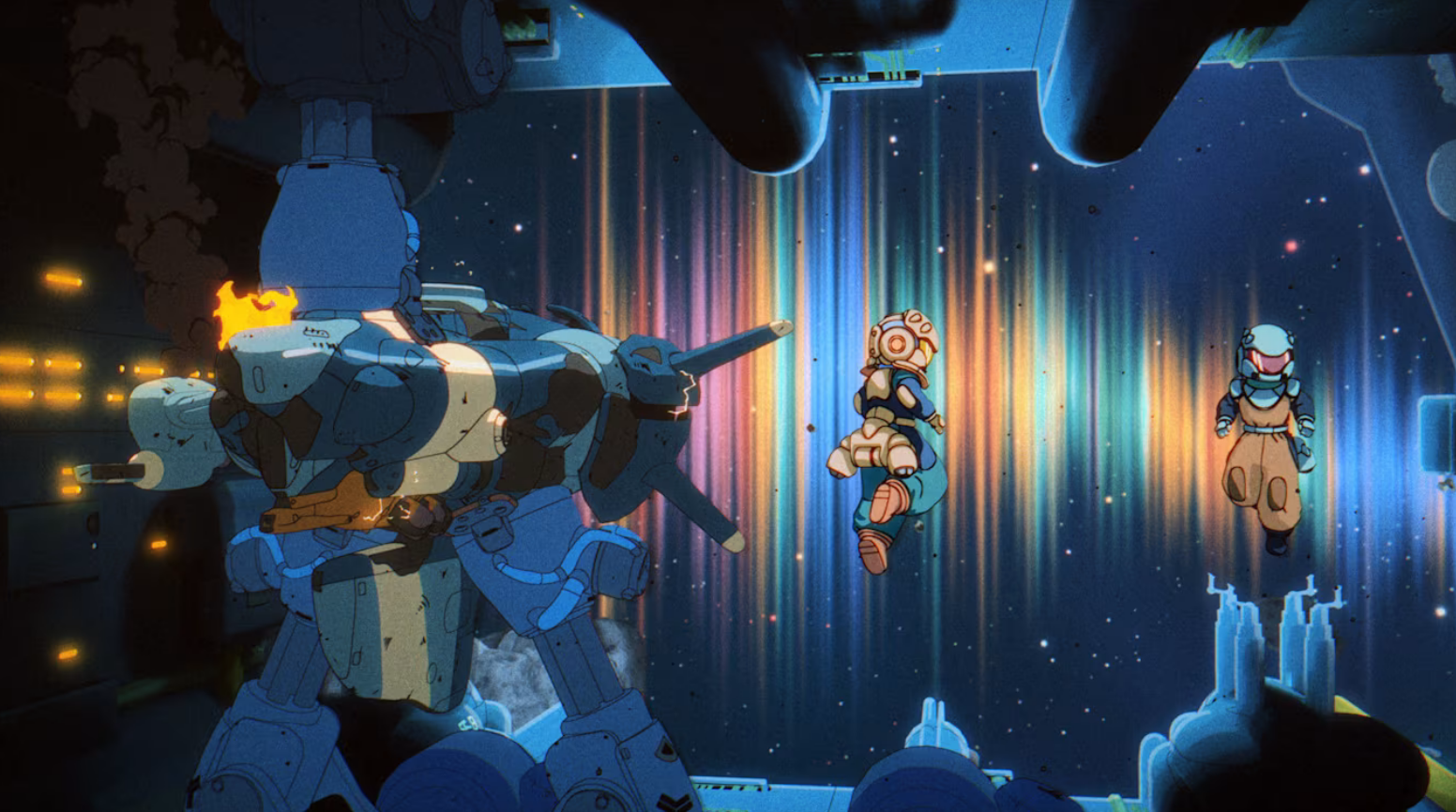
In Space No One Can Hear You Shout At Your Friend
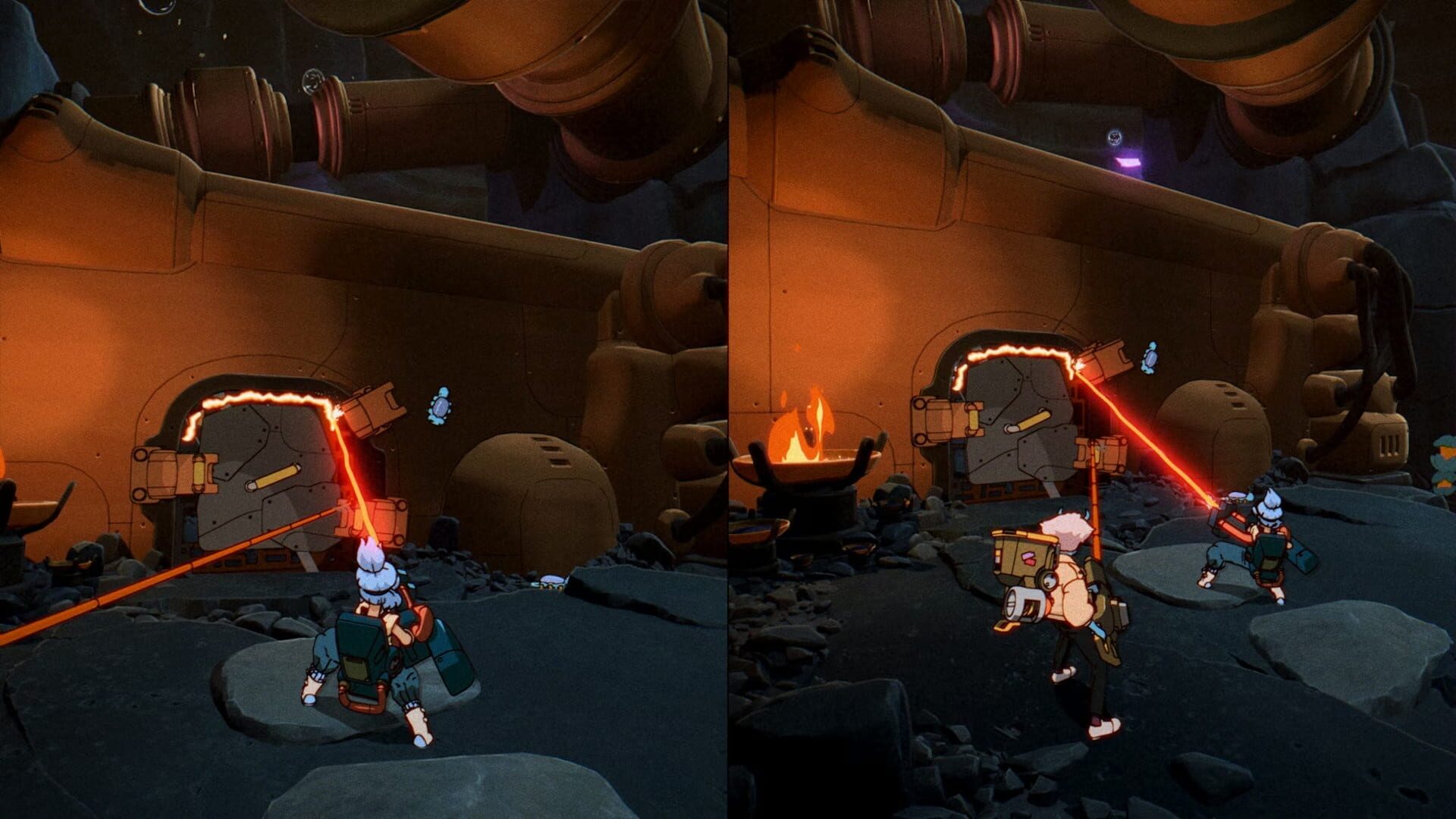
Orbitals has created the bulk, but by no means all, of its coop challenges around mastering four space tools; the Scrap Hook, the Liquid Launcher, the Beam Cannon, and the Spirit Microwave. There is also a few rocket packs, Ground Pounders and bubble creators, but they generally only last one challenge. Each of the four main ones can be picked up by either Maki or Omura, so there’s a lot of freedom of choice to begin each challenge, and you aren’t stuck with just having one character-specific tool. The Scrap Hook uses the triggers to grab and pull things, the Liquid Launcher shoots cold liquid into places, and the Beam Cannon is a laser that heats or powers. The Spirit Microwave comes a little later and allows you to control the spirit inside strange machines.
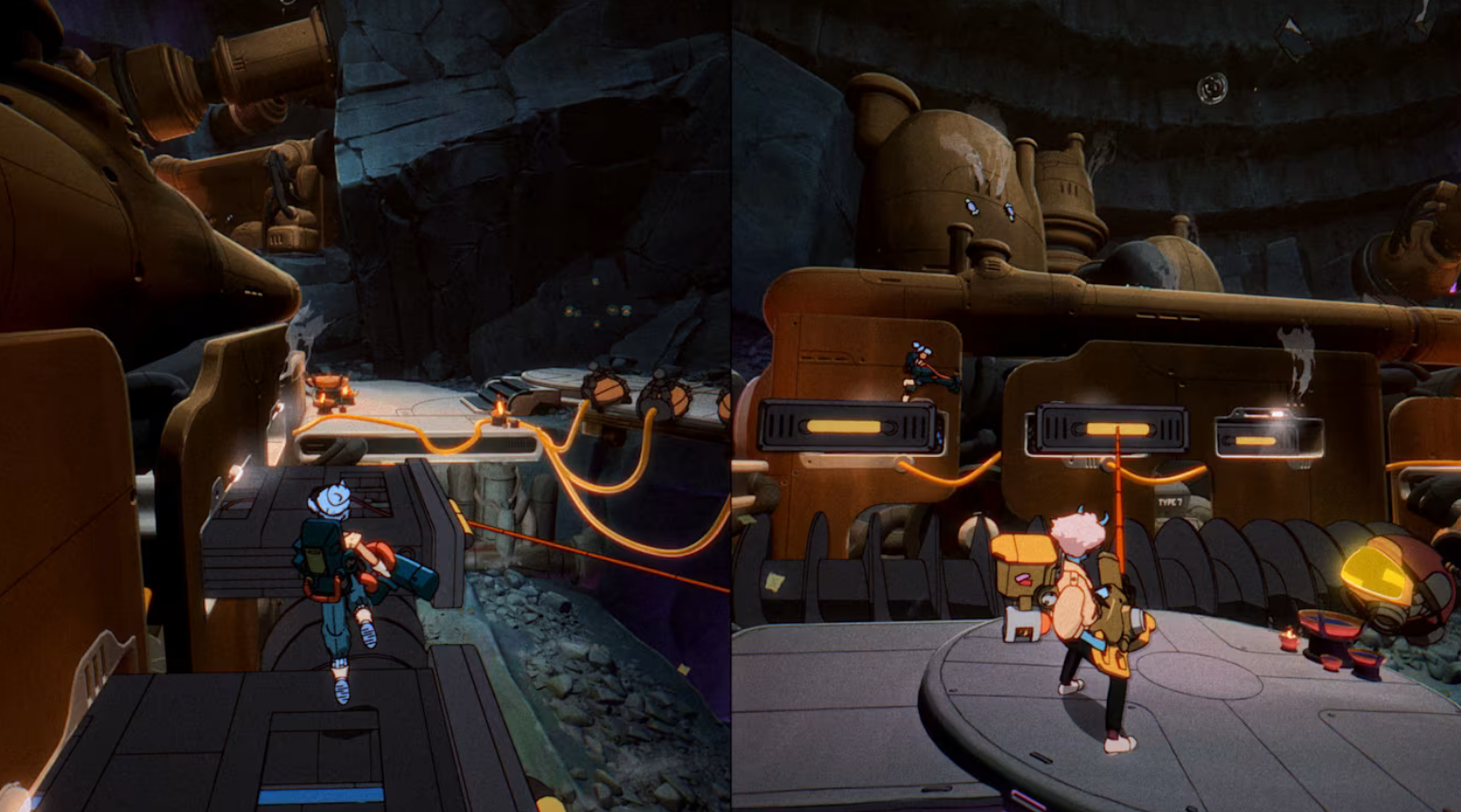
There are two of you, so every challenge makes use of a combination of two of those tools – heat up a girder with the beam, and then bend it out of the way with the hook; hook open an engine door and squirt liquid on the fire. Then add the dimension of not being in the same room, or being in and out of the ship, or stuck on a top level and a bottom level. Controlling robots around a room and opening doors at the right time, creating platforms, coordinating timed sections, throwing items across great divides for your partner to catch – I completely lost count of the sheer invention of coop challenges on offer. There were variations of things we’ve seen in other games, but there were dozens of challenges I’ve never had to solve before in all my thirty years of gaming.
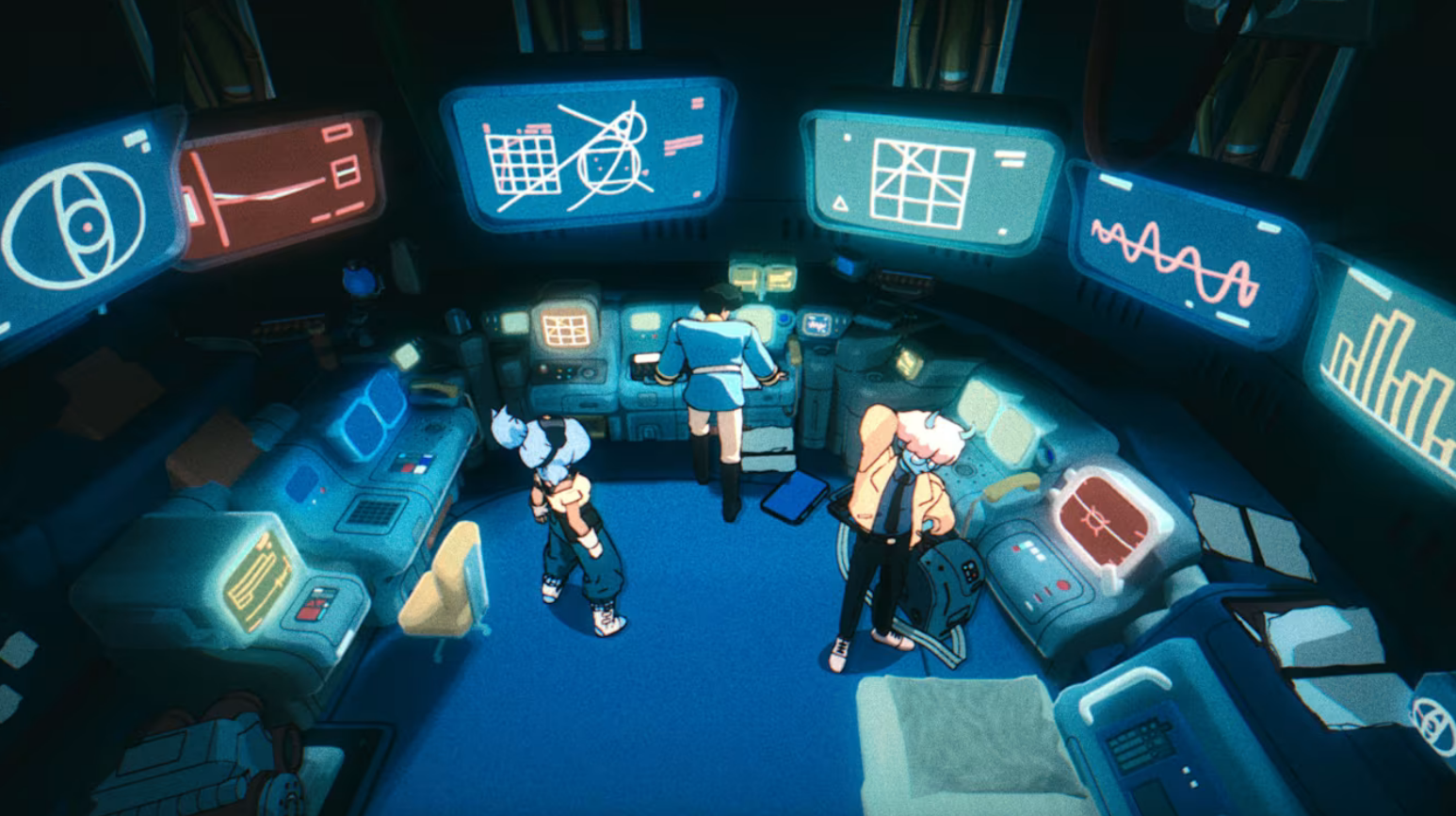
Sphere Of Influence
Orbitals must be played on two separate Switches (one must be a Switch 2) rather than with two Joy-Cons; however, it still splits its screen. Splitting the screen is kind of genius – yes, you need to see what your character is doing, but splitting the screen allows you to coordinate more effectively if you can see A, what your partner is doing, but also B, where they are looking/aiming. You can more effectively time your actions, see the numbers or colours or changes that they are seeing. Platforming especially involves timing and making platforms for your partner as they jump – very difficult if you can’t see.
A small gripe, but not one that’s going to be detrimental to the score here – Orbitals does require considerable gaming dexterity, combining character control, tool control, and then aiming the camera at the right spot. As anyone who has ever played with a more casual or non-hobby gamer, or even just a young gamer, will attest, sometimes they can’t control the camera, for example, and that can make most of the challenges here have one dimension prove even more difficult – aim.
Possibly the inclusion of a camera that stays behind the player, or a look-at-your-partner button would be a useful inclusion for any updates. On the other extreme, if you and your partner are the kind of players who are right at home completing a Souls game, then you will fly through Orbitals with little challenge, but hopefully a lot of fun.
Falling From Space
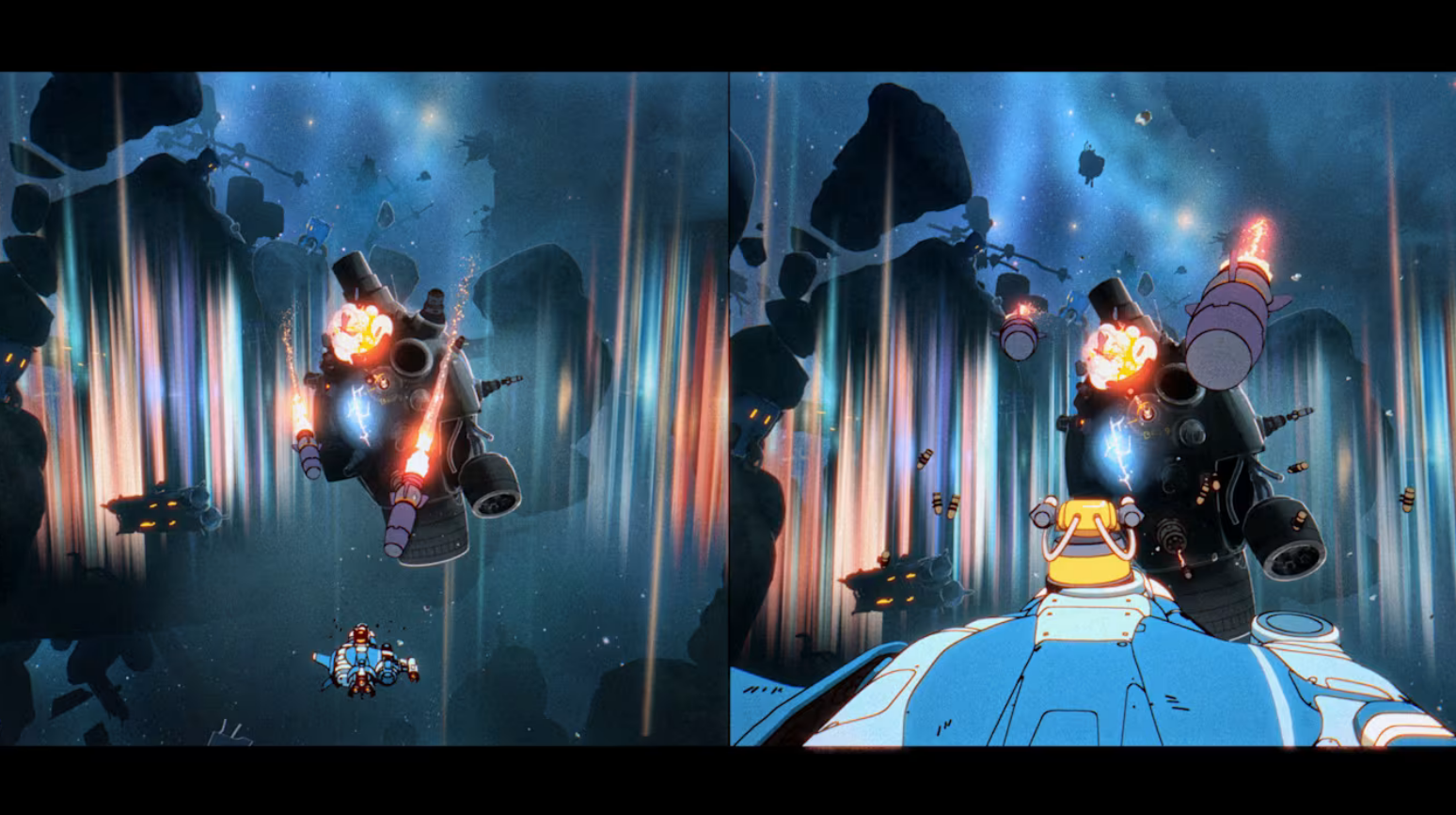
Maki and Omura go on their resource runs using their own coop spaceship – one of you flies and dodges, and the other uses the gun turret to slay those pesky asteroids. There are a number of space battles that require fast fingers, and dodging all over the place, while your partner tries to clear the screen of missiles and turrets.
One place Orbitals control system actually does simplify things is in spaceflight – you aren’t really flying in a fully 3D environment, rather on a sort of invisible single plane where you can manoeuvre about left and right, but not actually fly up or down. In the end, my son and I were grateful for this, as we got turned about and stuck during spaceflight quite enough without adding another axis.
Personal Space
Even with genre-reinventing coop, your own ship, and a great pair of characters, Orbitals wouldn’t have even caught my jaded eye had it not been for its vibrant aesthetic. It really is akin to playing through your very own 80s anime, and I loved every frame of gorgeous stuttery artwork and beautifully designed levels with the pod-like sci-fi theme they’ve gone for. Some of the levels were just incredible, like the third reactor’s more ‘space garden’ design, or the super hard deep-mine levels filled with fire challenges.
Add to that a wonderful city pop, or 80s J-pop anime theme, and a whole host of enjoyable level themes with great hooks, the soundtrack was remarkably good throughout. Another game where even long after the credits roll I’m going to be revisiting the soundtrack as I write and work.
The last thing that needs calling out is the inclusion of a bunch of fun and simple mini-games. You can collect these by going a little off the beaten track, and there were maybe ten in total; they then appear in your ship and can be accessed at virtually any downtime moment. Some were competitive, like racking up points catching capybaras on a conveyor belt, while others were more cooperative, like trying to shield the same defenceless ship from attack. When we couldn’t embark on a 30min to an hour-long gaming session, my son found these games to satisfy the urge to play for a shorter stint.
Save Space
Which leads me to my main issue with Orbitals. It’s a doozy if you read it and see yourself having this issue. But it could also cause you no trouble at all if your gamer buddies are like-skilled and have the same amount of free time.
So, Orbitals saving structure/frequency is currently appalling. Every larger mission objective seems to be an autosave moment, but these are only the main mission objectives and are few and far between. There is no autosave during the dozens of smaller individual cooperative moments you are handling with your partner as you achieve the larger objectives. Each puzzle, each time you survive a series of jumps in a room, each breather between challenges should be an autosave.
There are multiple reasons for this that I encountered. The Switch 2 is a bitesize handheld gaming system; you should be able to play for mere minutes at a time – instead, 30 mins, maybe as much as an hour, can pass before achieving an autosave. Gamesharing and Friend Pass are internet connection dependent, and connection can drop out. Orbitals claims to be an online-dependent game. When the connection drops, guess what, you lose all progress since the last autosave. An always-online game needs to be saving constantly.
This really needs to be patched as soon as possible – either to allow a manual save after virtually every single checkpoint, or to make every single current restart point or checkpoint (of which there are many) a full autosave. It materially affected my ability to play the game, let alone my ability to enjoy it. I could not embark on play sessions of an hour at a time every day; life happens. On a two-player coop-dependent game, two people’s lives happen.
Lastly on this, the game says it is Nintendo Online reliant – but this is only for online with a stranger. You can just cancel the connection to Nintendo Online if you don’t subscribe and play locally via Gameshare or online via Friend Pass without it.
Around the World, Around the World
Orbitals is an absolutely wonderful cooperative experience, and the indie game reason I bought the Nintendo Switch 2 system. By definition then, Orbitals is a system seller. It’s demanding but highly rewarding, dishing out challenge and fun, laughs both scripted and emergent. It’s aesthetically the most perfect recreation of an 80s anime gaming has ever achieved.
While it’s not technically perfect and lacks much plot, I found the characters of Maki and Omura endearing and charming throughout. I loved the character writing, and the dialogue was wickedly funny. It’s incredible, the sheer weight of coop challenges it had for me and my son to play together. It played its own role as a fantastic bonding tool for us, and I’d recommend it to parents of children around 7 and up. Whether it’s your son telling you how best to steer robots, or being wonderfully surprised at his ability to see solutions to puzzles my old dad brain wasn’t up to, Orbitals gave us many hours of fun, and will be a pleasure to revisit in future.
Orbitals is out on 3rd September 2026 only on Nintendo Switch 2.
Developer: Shapefarm
Publisher: Kepler Interactive
Disclaimer: In order to complete this review, we were provided with a promotional copy of the game. For our full review policy, please go here.
If you enjoyed this article or any more of our content, please consider our Patreon.
Make sure to follow Finger Guns on our social channels –Twitter, Facebook, Twitch, Spotify or Apple Podcasts – to keep up to date on our news, reviews and features.