

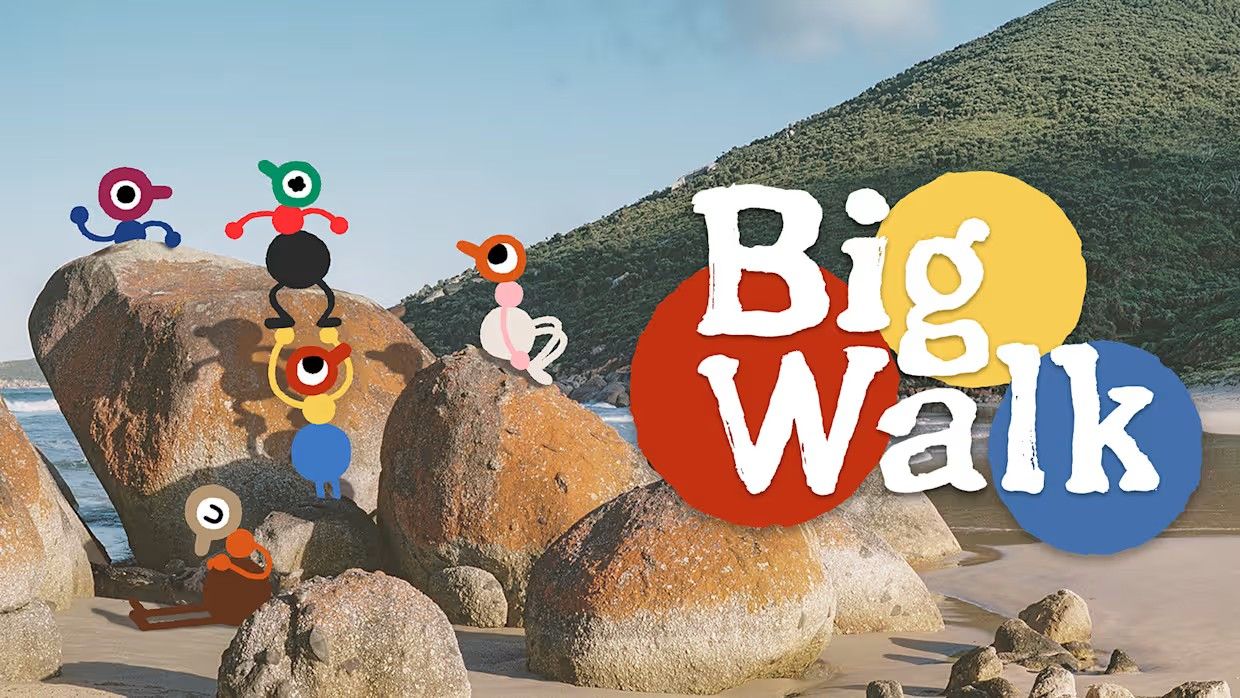
Friendslop is a term coined by players for explicitly co-operative multiplayer games, with an emphasis on the social aspect. A throwaway term to put a group of games in a box, or a derived phrase to describe it, slop carries the implication of something thoughtlessly thrown together. However, House House’s latest game, Big Walk, hasn’t got an ounce of “slop” in it. Everything about the game’s design is meticulous; whether that’s the co-operatively focused puzzle solving, the naturalistic sense of discovery, or the organic amount of baffoonery you and your companions will undoubtedly get up to, Big Walk is the new standard of multiplayer activity-based games.
It’s a game that operates with two cores: puzzles and what I’ll call ‘the social’. You and up to 11 friends can join in on the controlled chaos of Big Walk in an open world set on an island. There’s no context to what you are – though the Finger Guns crew and I referred to ourselves as Pingus – or what you’re doing there. All we knew going in was that we had to work co-operatively to solve loads of puzzles. And when we didn’t feel like doing puzzles, we just hung out, messed around with some of the items the sandbox offers, watched sunsets in some pretty parts of the island or caught up with each other.
Whilst the who I spent my time with in Big Walk contributed much of my enjoyment, it’s House House’s well-thought-out execution that facilitated such fun to be had with friends. This may be a heavily anecdotal review compared to my others, but the most fascinating aspect of Big Walk is understanding how the game ticks, and why that works to create such a brilliant multiplayer experience. Let’s walk and talk this one through, shall we?
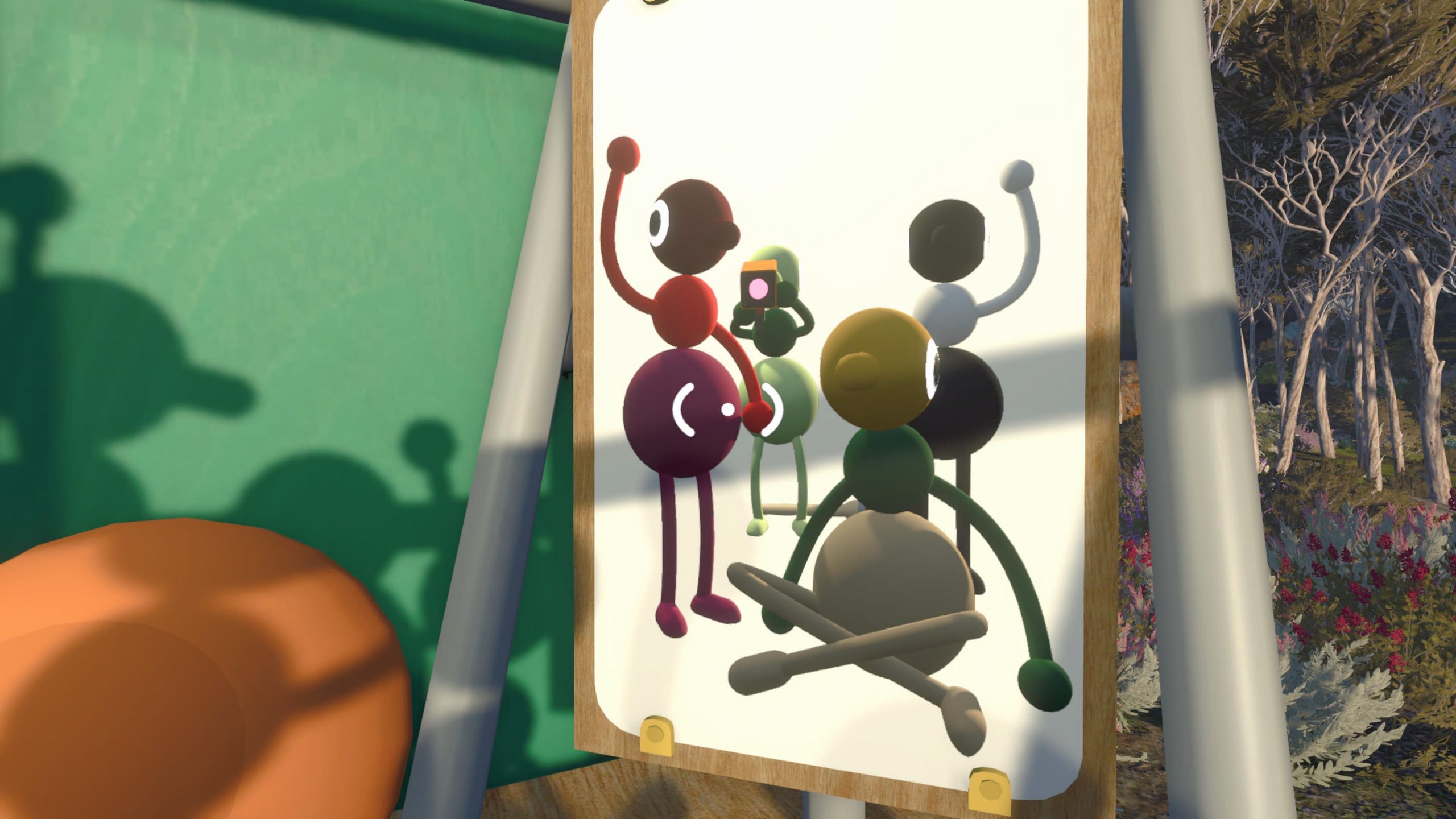
As of the time of this writing, we’ve not beaten Big Walk. Trying to get four of us together during our schedules has been a logistical nightmare. However, I’ve seen a good portion of the game amongst a rotating cast, with Rossko being with me for most of that journey; shout-out to you, Ross. Playing from the first-person perspective, you’re very plainly given a playground to learn the basic mechanics of the game at the start. There you’ll learn the different controls for arm movements, how to interact with objects, pick things up, and even punt them as far as you can. It’s a simple set of controls that bloom into quite a Narnia’s wardrobe of opportunities when contextualised.
Simon Says-ing became a game of Telephone, which then became repeating gestures like pass the parcel. There’s an amazing sense of puzzles progressing as your understanding of the game’s mechanics familiarises itself. Just when you think you’ve got a hang of what Big Walk throws at you, you’re met with a new challenge to learn, all without feeling convoluted. This is just one version of puzzles that requires two sides of your party to match each other’s tiles based on pictures; there are a slew of activities that tackle different parts of your brain.
One puzzle that would stump one of us would be a quick solution for another and vice versa. It made for a fairly well-paced experience on the whole. No one puzzle would encroach too much of our time – except for you, peg puzzle! – creating a loop of “just one more” amongst us until we were all playing later than we should be. Some players may find frustration in some backtracking to get a piece of equipment that will help your puzzle solving. That said, with some good planning and coordination amongst yourselves, you can circumvent a lot of those issues.
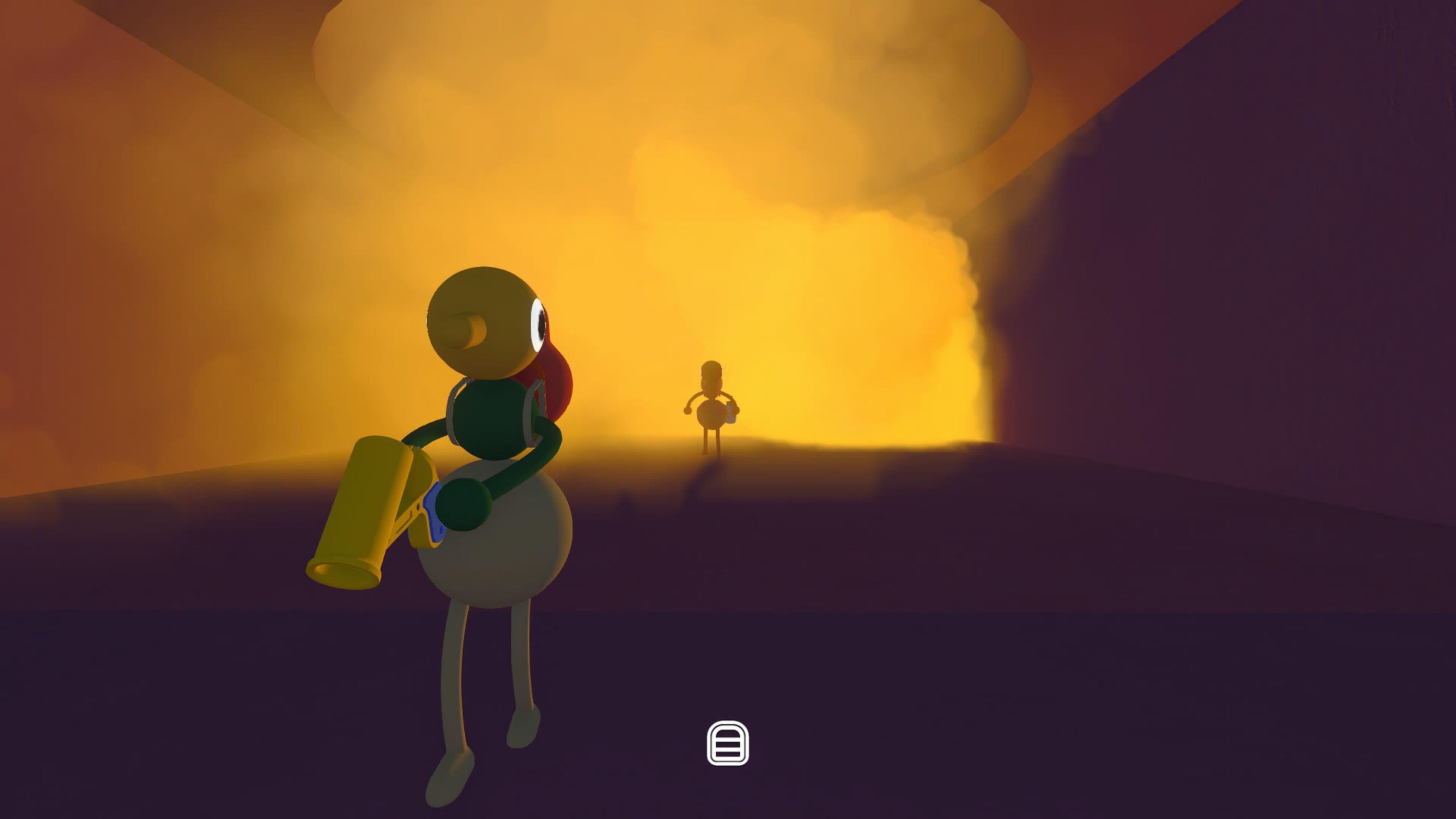
Some of this prep is also based on how you communicate, which is a staple to succeeding in Big Walk. This isn’t the first time a release has utilised proximity chat, but this might be the first instance to use it in tandem with the rest of its gameplay mechanics. So much of the game could be cheesed if you could just speak to each other on a party chat, but you’d be missing the point, and those addictive a-ha moments if you were to do so. Your voice echoes when you’re atop mountains, it’s directional to who you face in-game, and it’s taken away from you in puzzles when you’re in soundproof rooms.
It makes its implementation so effective, and the puzzles that much more rewarding when you gather to celebrate. There’s more than just glory when finishing the game’s challenges, as each one rewards you with red Matryoshka-like dolls that we affectionately dubbed as eggs. Once you’ve garnered a few of them, you can take them to towers to be placed inside these contraptions, unlocking new elements to the map. Things like a railway system, tunnels, and a room showcasing a large-scale map unlock as you progress with earning these eggs.
This makes a lot of your navigation feel rewarded and respects your time by making the trips back and forth quicker. As I mentioned, we don’t know why we’re doing it, but we’re having a lot of fun doing so. However, there is a mystique about the island, like there is an iceberg to Big Walk we’re yet to discover. But that’s not our sole motivation for seeing through to the end, as the moment-to-moment is some of the best I’ve had in years.
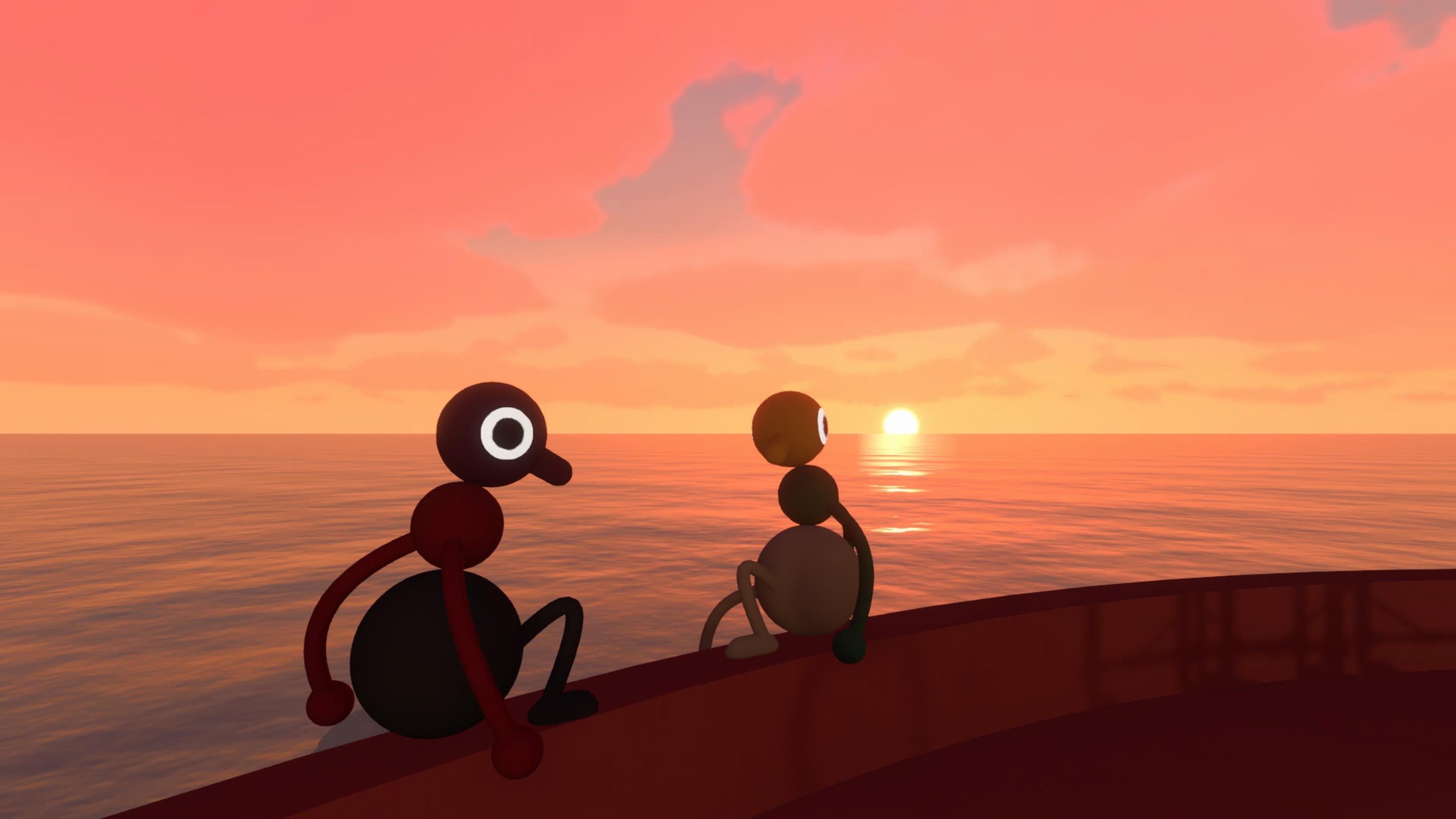
The social. Big Walk’s emphasis on creating a space for friends to muck around in is hard to compare. Much like the game’s primary objective of giving you a sense of freedom through completing puzzles and challenges, there’s a naturalistic playground for yourself and others to get goofy in. This led to opportunities where we created some of the fun we had. Whether that’s making the wearer of a backpack a pseudo-pariah of the group, reminding Ross every 20 minutes that he looked like an Oreo, or singing the Titanic theme tune poorly as I dropped Kat’s AFK body off the tower, none of it is engineered, feeling forced.
This is because, through its puzzle solving or social interactions, Big Walk isn’t a game urging you to do anything but exist in the island they created. House House supply the tools, the space and the objectives, whilst you and your friends provide the laughs and brains to make the most of it. And to that degree, it’s ingenious; there’s a level of craft that entrusts you with an amount of urgency to make the most of it, as opposed to being told what or how to have fun in a game.
It made Big Walk utterly refreshing to play as it contends with bigger budget multiplayer games. There’s obviously so much I can divulge about what’s actually in the game, but the charm is your own discovery. I’d be doing you a disservice if I gave away all of its special magic. The only thing left for you to do you is put on your headset and get out there with a group of your mates and embrace it all, one step at a time.
Big Walk is out now for PlayStation 5 (review platform), Nintendo Switch 2 and PC via Steam
Developers: House House
Publisher: Panic
Disclaimer: In order to complete this review, we were provided with a promotional copy of the game. For our full review policy, please go here.
If you enjoyed this article or any more of our content, please consider our Patreon.
Make sure to follow Finger Guns on our social channels. Twitter, Facebook, Twitch, Spotify or Apple Podcasts – to keep up to date on our news, reviews and features.
COMMENT
I like how Big Walk focuses on cooperation and lets players create their own fun instead of forcing everything through the usual multiplayer formula. The proximity chat and puzzle design sound especially interesting, and the way the island gradually opens up as you progress is a nice touch.